Showing posts with label Archives Month. Show all posts

09 October 2025

Tips for At-Home Preservation of Photographs: An Archives Month Display by Cassandra Knoppel

Happy October, dear friends! 

Fall is finally upon us and so begins the time of year when BDC staff and laypeople have the most in common - bundling up in sweaters, sipping hot tea, spending more time indoors and less time in the sun than is probably recommended by health professionals, and feeding into one's interest in history, death, and the macabre! While normal folks are out picking pumpkins and deciding on costumes for Halloween in October, BDC staff and other archives professionals are celebrating American Archives Month (and Halloween - we have personal lives too, you know!). If you are interested in being even more like us this month, this is the blog post for you!

As part of this year's celebration of American Archives Month, and in a belated nod to last month being Save Your Photos Month, the BDC wanted to share tips with our readers on how to take care of precious photographs at-home. I've designed both a display and a short guide in the form of this post that answers some of the top questions when it comes to photograph preservation. So, let's get started!

Shelf One: An Introduction

First on the shelf is Mary Lynn Ritzenthaler’s Photographs: Archival Care and Management (2006) - our photograph preservation "bible." It is a detailed guide to handling, assessing, and storing photographs for professionals, but anyone curious about archival standards for photographs can benefit from reading it. I often re-read the chapters on identifying types of photographs and the methods for housing each type. The Graphics Atlas, an online resource, and NEDCC's Preservation Leaflets Types of Photographs, parts 1, 2 and 3 are also incredibly helpful when trying to identify old photo types.

Caring for Your Family Treasures: Heritage Preservation (2000) by Jane S. and Richard W. Long, is a handy primer for long-term care of personal artifacts for non-professionals. With chapters on photographs and scrapbooks, this book outlines best practices for preserving and conserving these heirlooms with helpful tips and tricks. The author also points to additional resources for more in-depth study if you are so inclined.

Shelf Two: How should photographs be stored?

Pinned at the top of this shelf are short summaries of best environmental conditions for the safekeeping of photographs. First, it is best to store materials somewhere safe from huge swings in temperature and humidity levels and away from potential sources of water, pest, or UV damage. Attics, basements, sheds, and garages are not safe storage areas because they are often not temperature or humidity controlled, can be pest "hot spots," and are more likely to flood or experience leaks. Instead, find a spot in your home that is climate controlled, off the floor, and not in direct sunlight (to prevent fading due to UV damage) to store your photograph collections. NEDCC's Care of Photographs Preservation Leaflet goes into greater detail on proper storage. 

Next, house your photographs in proper containers. NEDCC also has a Preservation Leaflet on Storage Enclosures for Photographic Materials, but in the display I have a copy of Gaylord Archival's Guide to Collections Care (2016) opened to page 22, showing how materials like photographs can be housed – first in an archival-safe plastic or paper sleeve, then in an acid-free folder within an archival box. That seems fairly straightforward, right? And it is... so long as you have the right paper and plastic sleeves! Sleeves need to be P.A.T. tested and safe for photographs. If they aren't, you risk the surface or emulsion of the photograph adhering to the sleeve or the acid of the sleeve eating away at your photo.

On the shelf are surrogate copies of photos we hold in our collections in a variety of sleeves, showcasing the ideal ways a photo could be archivally stored. Paper sleeves are opaque and help to prevent UV damage, while also being easier to label with pencil. Paper sleeves must be acid- and lignin-free. Plastic sleeves are more transparent, which allows for clear identification and viewing of the photo without having to remove the item from the sleeve itself. However, you must be very careful when choosing plastic sleeves that you are using the right plastics. Gaylord Archival has a helpful infographic, Know Your Archival Plastics, that breaks down the safe and unsafe options. PVC (polyvinyl chloride) sleeves are the most commonly offered sleeves - usually as three-ring sheet protectors or scrapbook sleeves, but PVC sleeves are not safe for long-term storage of photographs (even if the box of sleeves says archival!). PVC degrades and off-gasses chemicals than can damage and degrade the materials housed within it, so PVC is never recommended for storing archival materials.

Instead, polyester, polypropylene, and polyethylene sleeves are the safe choices for plastic sleeves. Polyester, also called Mylar, is considered the best as it is the clearest and most rigid option, but it is more expensive than the less clear and rigid polypropylene. Polyethylene sleeves are also a good option, although they are more opaque and flimsy.

Shelf Three: How should photographs be handled?

This shelf prominently displays two pairs of gloves. Why? Well, archival standards dictate that gloves be worn when handling photos to prevent oils from our hands sticking to the photo's surface and causing damage. Gloves aren't required for use with paper-based materials like books and documents, but photographs are more sensitive to damage from oils and dirt.

The stereotype of an archivist or museum curator is that of someone wearing a cardigan, loafers, and white cotton gloves. However, white cotton gloves are no longer the industry standard, at least where photographs are concerned. Cloth gloves were the standard due to their availability and cost effectiveness; these types of gloves are washable and reuseable. However, they can pick up dirt and dust from surfaces or absorb moisture and oils from our hands and transfer them to materials. Cotton gloves are often loose fitting, which can create issues with grip, and reduce our tactile sensitivity. The fabric of the gloves can also snag on rough, brittle edges, causing breakage.

Nitrile, latex, and vinyl gloves are now the standard for use with archival materials, especially photographs. They create a moisture barrier, are more close-fitting, are less likely to snag, and don't pick up dirt and dust. In the BDC, we use blue nitrile gloves like those you see on the shelf.
    
Bonus Tip: Labeling photographs

Labeling your photographs is important, as it provides context on who is in the photo along with when and where it was taken for future viewers. However, you should not label your photographs with pen, nor should you write on the front of the image. Instead, label the backs of your photographs preferably along the edges with pencil and light pressure or with acid-free ink so as not to damage the image on the front! We know that this can be hard if there are several or more people in the image. In that case it may be prudent to sleeve the photograph in an acid-free, lignin-free envelope so that you can record the identities of the people and details of the event and/or date of the photograph. 

Shelf Four: What if my photograph is damaged?

In our hot and humid, and hurricane-prone climate, water damage is not uncommon for collections. NEDCC has a helpful guide on how you can salvage wet photographs and dry them safely so that they can be preserved. The CCAHA also has a very thorough article on the topic, too.

With photograph collections, we've seen water damage lead to photographs sticking to each other. Included on the shelf in my display is a sheet that discusses how one can try to separate photographs that are stuck together, originally written by University Products for Preservation Week. The process discussed in this handout was highlighted in a previous Connections Blog post that Grace wrote: Preservation Q & A on Smithsonian Institution Archives Blog. That being said, the method is not actually recommended by the Smithsonian or other conservators as re-wetting the photographs risks separating the image from its back, ink running, mold, and other issues. Instead, there is not much that can be done for stuck photographs.

Another not-recommended remedial issue is tape. Using tape to mend torn documents is fairly typical for non-archivists, but in the archives, the use of tape is highly discouraged. The adhesives in tape are acidic and can stain and otherwise damage the material they are stuck to. Eventually, the adhesive gives way, leaving only the residue behind and you're back to having a torn and separated item again. Instead of using tape, house the parts of the photograph together in an archival sleeve in a position as close to the original arrangement as possible.

That being said, it is important to remember that prevention and preservation are much easier (and cheaper) than remediation and restoration!


I hope you all enjoyed this discussion on photographic preservation, and I hope even more that some of you will feel encouraged to don an "archivist costume" for Halloween and try out these tips!


References: 

Northeast Document Conservation Center, 5.3 Care of Photographs(2007, revised 2019). 

Library of Congress, Care, Handling and Storage of Photographs, (2002).


Photo Managers, Save Your Photos Month 2025 (2025). Tip: You may want to check out the organization's YouTube Channel for informative videos.  


Gaylord Archival, For the Glove of Preservation (n.d., accessed 9 October 2025).

Gaylord Archival, We Need to Talk About Tape (n.d., accessed 9 October 2025).

Gabriel Dunn (The Strong National Museum of Play), To Glove or Not to Glove: Wearing Gloves for Collections (2023).

Amy Sampson (The National Archives UK), Handling Historical Collections: The Gloves are Still Off (2023).

Cathleen A. Baker and Randy Silverman, Misperceptions about White Gloves. In International Preservation News, No. 37 (Dec. 2005).

Smithsonian Institution Archives, Separating photos that are stuck together (2011).

06 October 2024

Archives Month 2024 Display by Cassandra Knoppel

Cassandra Knoppel is this month's curator of the BDC Research Room display case. My comments are in italics. -- gmc

Happy American Archives Month! It’s that time of year again where archives, special collections, and other cultural heritage institutions celebrate and promote the work of archivists in preserving records of enduring value. In celebration, I have put together a display that answers common questions about our archive and the field in general, expanding on my prior preservation display from April 2024 and hopefully offering some more insight into what we do here at the BDC. 
Shelf 1: What are archives? 
I started us off in the top shelf by defining archives and showing the varying types of materials archives can hold. The Society of American Archivists Dictionary of Archives Terminology has five definitions for the noun Archive, including “a physical or digital collection of historical records.” Archives hold material of current and future historical value including files and documents, rare books, photographs, maps, posters, and so much more. Researchers looking for the answer to a history or genealogy question can stumble upon untold stories hidden in these primary source documents only available in archives.  
The article “Using Archives: A Guide to Effective Research” by Laura Schmidt is a “short-and-sweet” introduction to archives. Schmidt outlines the aspects of archives that make them stand apart from libraries and the different types of archives, while also describing how to find and make use of archives during your research and what to expect during your visit to one. In my opinion, this should be mandatory reading for all researchers and visitors to archives (and I’m not just saying that because it was mandatory reading in my Intro to Archives course!)
The pamphlet “Placing Your Family Papers in an Archival Repository” by the SC State Historical Records Advisory Board is another quick guide that goes into more detail on how archives collect and present historic material. Copies of this pamphlet and the Schmidt article, unlike most of our materials, are available to take home from the BDC. 
Not every archive holds the same materials, nor does it serve the same function. While the BDC is a local history archive serving Beaufort County, other archives collect material related only to state politicians or governmental agencies or have broader scopes by collecting historical materials from across the state. The featured guide, Directory of Historical Records Repositories in South Carolina edited by Jeanette Bergeron (2000) (SC 025.171 DIR), lists some of the many archival repositories in South Carolina including ours at the BCL, and others like MUSC’s Waring Historical Library, the South Carolina Department of Archives and History, University of South Carolina's South Caroliniana Library, and the Catawba Cultural Preservation Project archives. While this is clearly an older and outdated edition, it does serve as a concise overview of the repositories within South Carolina and the current information for each archive can be easily found online. As the SC Archives Month poster from 2007 (SC Poster #200) proclaims, “There are over 100 historical societies, public libraries, museums, colleges, universities, and other locations across the Palmetto State with archival riches to be discovered.” We’re proud to say that the BDC is one of them! 
Shelf 2: What is the Beaufort District Collection? What do you do? 
The Beaufort District Collection (BDC) is the Beaufort County Library’s special local history and archives collection. The purpose of the Beaufort District Collection is to acquire, preserve, maintain and make accessible a research collection of permanent value that records the history of the area of Lowcountry South Carolina known as the old historic Beaufort District. The BDC began as a shelf in the Beaufort Township Library, then became a closet in the 1964 Library building, and by 1992 a South Carolina Room's worth of local history materials on the first floor of the Beaufort Branch Library. (We are still using some of the furnishings that the Beaufort County Historical Society provided back then now.) As the pamphlet from our Vertical File on the BDC shows (yes – we collect archival material on our archive too!), we later became our own department and campaigned to move to our present larger space on the second floor under the careful eye of Grace Cordial, Grand Poo-Bah of the BDC 😊(That you think of me as Grand Poo-Bah makes me smile, Cassi, but in all honesty I think of myself in more regal terms - as the "Queen 👑 of the BDC." BTW: It took me 9 years and 16 days from the initial "ask" for more space to move the BDC to our current quarters. I am a persistent cuss when I believe in a project.)
The BDC now holds almost 250 archival collections related to the history, people, and events of Beaufort County. 
I discussed some of the “behind-the-scenes" work that archivists do in my last display for Preservation Week, but the short story is that BDC staff and volunteers prepare collections for public use through arranging, describing, and preserving collection materials (called processing). We then facilitate that use during reference appointments while also promoting our holdings and sharing local history through programs, displays like this one, brochures, flyers, resource guides, and social media posts. Ways to see and access our collections are described in our BDC brochure and our most recently processed collections are featured in the “What’s New at the BDC” brochure (copies are available outside of our Research Room door). 
Shelf 3: What types of records do you have? How can they help my research? 
The BDC holds a WIDE variety of records of historical value, in both physical and digital formats. A broad list of types of materials that archives hold is posted in the display. A few examples (as depicted in the surrogate versions on the shelf) include photo slides, floppy disks, prints, postcards, photographs and stereoscopes, manuscripts and typed documents. 
Our collection is designed for in-person research, but did you know that you can access some of our resources virtually too? Our new “Virtual BDC” flyer lists all of the ways you can view some of our collections and resource materials from home. (Or you could just join us on October 10th at Port Royal Branch Library for a presentation about the Library's Digital Collections. Just saying.) You can also view some of our archival collection’s finding aids and resource guides on special topic areas on our BDCBCL: Links, Lists, and Finding Aids blog 
When it comes to research help, we serve many purposes. For example, we often get customers looking to start their family tree research, and although we are NOT a genealogical library, we do have a few tools to help. Looking at census records is a great place to start! The SCDAH’s booklet, Census Records at the Archives (SC 929.1 TUT), is a handy primer available in our Research Room on how to approach Census research and what information can be found within different types of Census schedules. The BDC has SC census records from the years 1790 to 1930 available on microfilm. You can also access census records from Ancestry Library Edition from inside any Beaufort County Library, including here at the BDC (but it is advisable that you give us a heads up that you're coming.)
Shelf 4: How are archives different from libraries or museums? 
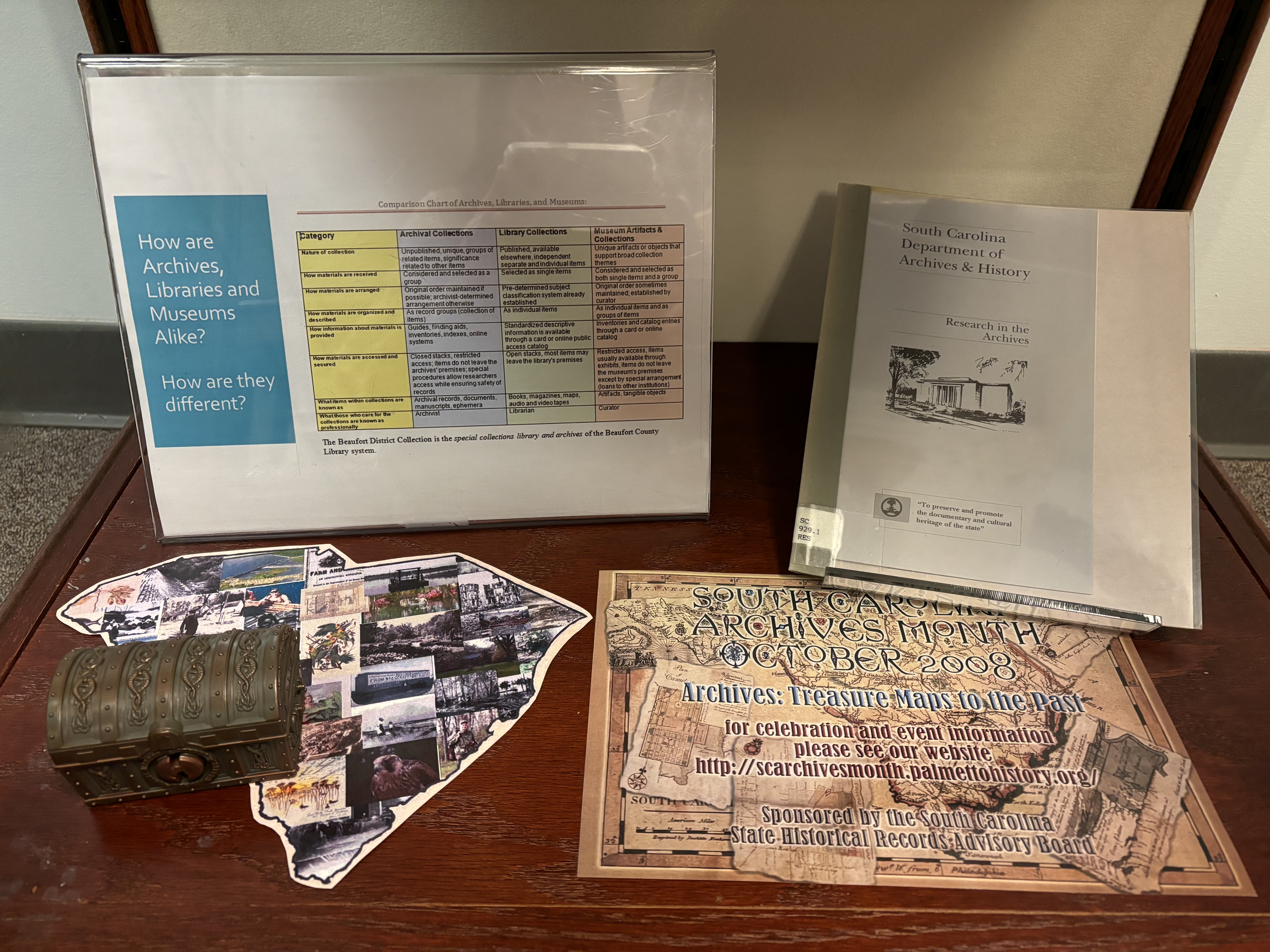
And lastly, another important topic to cover is the distinction between archives, libraries, and museums. While each type is designed to hold and present informational material, the scope, method, and manner of maintaining their collections and facilitating access varies between each. The chart adapted from the AASLH “Basics of Archives” course (2008) illustrates the similarities and differences between archives, libraries and museums. One key difference is the types of material they collect; libraries typically collect published material that is available elsewhere, museums collect unique artifacts and objects, while archives - as I discussed before - collect unpublished and unique material (typically not including objects). 
Now is a good time to state that archives often have special rules and policies to safeguard historical materials in our collections, not to burden patrons or prevent research but so that the condition of the items remain stable so people can continue to have access to them for centuries to come. The SCDAH’s booklet, Research in the Archives (SC 929.1 RES), concisely explains the role of the SCDAH, their services and their general holdings, while also outlining some of their access policies. The SCDAH’s policies are similar to those in the BDC - While libraries usually allow unrestricted access to their collections of books and DVDs, so long as you have a library card, archives and museums do restrict access to their collections – they do not allow patrons to walk up and select an item from the shelf to take home for a week. 
I hope that this exhibit gives you a new-found appreciation and understanding of archives and the role they play in our communities and in our exploration of history. As the 2008 South Carolina Archives Month poster (SC Poster #197) states: Archives are “treasure maps to the past” and you never really know what you might find during your visit. Make a research appointment with the BDC to see what YOU can uncover in our archives: bdc@bcgov.net OR 843-255-6468. 
A heads up: The Library system will be closed Monday, October 2024 for Staff Work Day.