Showing posts with label Black History Month. Show all posts

01 February 2025

What to Expect in February 2025

The shortest month of the year is often one of the BDC's busiest. It definitely is in 2025. 

In case you didn't complete your Winter Reading during the recent wintry weather, there's still time. We're half way through the Winter Reading Program and we have plenty of reading suggestions to share. Go for "Short" books with titles on the flyer:  

But if you want to explore local history topics in more depth, we suggest that you take a look at the BDCBCL: Links, Lists and Finding Aids blog. Here are just a few of the topics with some book recommendations: 

It's Black History Month. All the "Uniquely BDC" will feature items about Gullah history on Facebook in addition to our customary "Black History Note Wednesday" posts. You could choose some of the titles from the Gullah Culture flyer shown below to honor Black History Month and complete the 6 hours of reading benchmark for the Winter Reading Program.  (Just saying - or writing -- in this particular case.)

Or you can take a deeper drive into these Gullah related topics on the BDCBCL: Links, Lists and Finding Aids blog in honor of Black History Month - and still find more than 6 hours of reading's worth of choices to complete the Winter Reading Program:  

February happens to be National Library Lovers Month, too. Libraries and librarians of all stripes have been under a lot of stress in the past few years so we particularly embrace (figuratively, not physically - since that could get us in even more hot water) all you Library Lovers out there.


We celebrate Valentine's Day with a change of Research Room decorations and a "Love in the Archives" Connections post - both by our newest staff member, Sydney. One thing that she's done since her arrival in November is to select an item from our holdings, create a surrogate, and then feature it near the Researcher Registration book. It's a nice touch. I've decided that she should continue the practice going forward. 

Even though the Library will be closed on February 17, 2025 for Presidents' Day, I've written some posts about US Presidents who have visited Beaufort District and Beaufort County in the past that you could read as part of your observance of the holiday.


BDC staff will be meeting, greeting, and sharing information about the autobiographical and memoirs present in the BDC in the USC Performing Arts Center lobby at the February 10th Friends of the Beaufort Library Books Sandwiched In session. The featured book Black Boy by Richard Wright will be presented by Jeffery Blount.  

Programs-wise: The BDC has 4 local history programs scheduled this month. We're covering topics from the American Revolution to current digital offerings by the BCL in February. I have a particularly fond spot in my heart (See how I sneaked a seasonal Valentine's Day reference in?) for the BDC's own Cassandra Knoppel who will share some of the treasures and challenges she's had processing archival collections over the past 6 months on Wednesday February 19th. For those who came to her presentation in July, Cassi is talking about different collections this time - so please feel free to join us again.

We're also working on re-scheduling the 3 programs that got cancelled in January. As soon as those details get finalized, we will announce the new dates.

20 February 2024

Re-cap of Facebook Posts, January 22 - February 15, 2024

Honestly, most of the BDC's  Facebook posts during this particular period related to our local history programs: Sea Island Cotton; Shrimping Industry; Yamasee Indians; the Battle of Beaufort; and my outing as the Books Sandwiched In series speaker on February 5th. [The recording is here.] Thus the pickings are pretty slim. I posted a lot of photos of these events taken by Jalen or Cassi or me to the BDC's page. You should be able to see the images of the events even without a Facebook account. 

"Uniquely BDC" posts: 

January 22"Uniquely BDC: Materials Monday:" relates to our cotton program last week. "Port Royal, South Carolina, served as the base of operations for many northern cotton-growing companies. The syndicate for which Edward S. Philbrick was the agent was the largest of these, controlling some 8000 acres of Sea Island cotton land." The quote comes from New Masters: Northern Planters during the Civil War and Reconstruction by Lawrence N. Powell (Yale University Press, 1980), p. 15. The only copy of this title in the SCLENDS consortium is found in our Research Room. Make an appointment (843-255-6468 or bdc@bcgov.net) to come learn more about the Sea Island cotton industry during the Federal occupation, 1861 - 1878.

January 29 - "Uniquely BDC:" Materials Monday - I put SC PRINT 76 in the pre-program looping slideshow before the start of the local history program about shrimping at Bluffton Branch last week. Can you spot the folks shrimping? (Truth: I hadn't noticed them until Woody Collins pointed them out to me a few years ago.) We are the only library in the SCLENDS consortium who have this item listed in the catalog.

February 5 - "Uniquely BDC: Materials Monday:" I'll be over at the Friends of the Beaufort Library's Books Sandwiched In at Noon reviewing Caroline Grego's Hurricane Jim Crow (2023). Accordingly, today's highlight is our "Beaufort Hurricane of 1893" digital collection.

February 12 - "Uniquely BDC: Materials Monday:" The Storm Swept Coast of South Carolina pamphlet is one of the key resources for personal accounts about the Hurricane of 1893. The Beaufort County Library is one of the few libraries in the world to have original copies of this rare and uniquely local booklet compiled and published by Rachel Mather of the Mather School in 1894. You can read the booklet in its entirety through the BCL's long partnership with the Lowcountry Digital Library.

"Black History Note" posts:

January 31 - "Black History Note:" Among those fighting in the Battle of Beaufort was a free man of color, Jim Capers. He would stay with the Patriots all the way to Yorktown. Artist Jeff Trexler depicts him playing his drum on the battlefield in his painting "In the Glorious Cause of Liberty." He would drum during the ceremony at which British Gen. Charles O'Hara surrendered in place of Lord Cornwallis. You can read more about him and other African-American Patriots in the Southern Campaign of the American Revolution by Bobby G. Moss and Michael C. Scoggins (2004) in our Research Room.

February 7 - The Library has a Black History Month webpage that includes a lot of BDC "stuff." Check it out.

February 13 - Jalen changed out the BDC's display case in honor of Black History Month. Read about what he chose and why he chose the items in Connections.

February 14 - "Black History Note Wednesday:" "African Americans and the Arts" is the Black History Month theme for 2024. Explore the key influence African Americans have had in the fields of "visual and performing arts, literature, fashion, folklore, language, film, music, architecture, culinary and other forms of cultural expression" this month. I'd like to suggest that you begin by learning more about Jonathan Green. Jonathan Green's Seeking is a documentary by Charles Allan Smith about how an interest in Green's ancestors influence his art. A complement to the award-winning documentary is Seeking: Poetry and Prose Inspired by the Art of Jonathan Green edited by Kwame Dawes and Marjory Wentworth. Both items are available in our Research Room. Contact us to set up a time to come in: bdc@bcgov.net ; 843-255-6468 We have plenty more about this native son artist.

Finding Aid Fridays post:

February 9 - Now that Cassi is hard at work in the BDC, you will see periodic posts to the "Finding Aid Fridays" series again. Up first: The records of the oldest historical organization in Beaufort County, the Beaufort County Historical Society which turns 85 years old on Tuesday, 13 February 2024. Give us a call 843-255-6468 or email us bdc@bcgov.net to make an appointment to review the contents of this archive.

12 February 2024

Black History Month 2024 Research Room Display by Jalen Lugo

As I have mentioned before, I use creation of display cases as a way for new BDC staff to explore certain sections of our holdings in a deeper and more personal way. My goal is that staff will internalize how varied and multifaceted the BDC is - even when it is tied to a certain geographical area - so that they can better assist our customers.  The 2024 theme for Black History Month is "African Americans and the Arts." Thus I assigned Jalen, the BDC's Library assistant the task of highlighting some of the BDC's resources on that theme. He had the liberty to interpret the theme, choose the decorative elements, and then was required to explain to me and to you why he chose what he chose as illustrative of the theme. -- Grace Cordial 

Black History Month is upon us, and I have the pleasure of adding new items into the BDC lobby display case. This month entails all the culture, religion, and practices of the African American people in the U.S. Here at the BDC we strive to capture the stories of African American history and what makes them unique in our area. Everything found in the display case this month focuses on the Gullah community, which is only found in the southeastern United States, ranging from North Carolina down to Florida. The Gullah community contains unique religious practices, music, food, and language not found anywhere else in the world. 

Gullah Culture in America by Wilbur Cross (2007, 2008, 2012, 2023) is a book about the Gullah community across the U.S. since its discovery in the mid-1800s. The Gullah community was largely unheard of up until the mid-1800s, when, during the 1860s, a group of missionaries travelled down south to instruct freedmen how to read and write when they noticed that the freedmen spoke partial English combined with idioms, expressions, and such. What I find interesting about this book is how incredibly deep their stories are. The Gullah have their own language, songs, food, religion, and how they represent themselves in the community, all of which stems from their African roots. It is a world I previously never thought of but am now deeply entrenched in learning about.

Africanisms in American Culture edited by Joseph E. Holloway (1990) discusses African-based historical, linguistic, religious, and artistic perspectives that have been absorbed into American traditions. Together the chapter authors provide cultural context for African Americans, helping identify where certain religious, artistic, and linguistic practices are derived from and how the African American people use this to define themselves today. I chose this because it is interesting to discover where a certain ritual or practice was derived from, and how similar it is to the rituals and practices in Africa. This book can also serve as a starting point for those trying to trace down their roots because so many rituals and practices were specific to a certain group of people in Africa.

Shout Because You’re Free: The African American Ring Shout Tradition in Coastal Georgia by Art Rosenbaum, Margo Newmark Rosenbaum, and Johann S. Buis (1998) is about the African American Ring Shouting tradition. “Ring Shout” is a form of praise and worship for African Americans that involves a sort of call-and-respond form of singing, with a stick to beat on the floor for a beat, along with handclapping and foot-tapping. It was thought to have completely died out by the 1980s, but a small group was found that still actively performed this kind of practice. I chose this book because it discusses an unique style of singing that enslaved people created with what they have. How this form of praise and worship continues even today is a testament to the perseverance, passion, and soul that the African American community exemplifies.

Slave Songs of the Georgia Sea Islands by Lydia Parrish (1992, 1942) is a book about Lydia Parrish travelling far and wide to locate and document the different songs and style of songs that African Americans created and sang during the antebellum period. Parrish creates a delicate and intricate layer between their songs and their way of life, social customs, language, and culture. Parrish garnered the respect and trust of many African American song writers and was able to record their songs in detail, adding depth and providing context to discover the meaning behind them. I chose this book because of its intricate description of songs from the antebellum period and how she explains why, and how, they stood the test of time. 

Gullah: Songs of Hope, Faith and Freedom [Audio CD] (1997) by Marlena Smalls and the Hallelujah Singers provides a gateway to a culture that is largely unknown by many people in the U.S. According to the summary about this item in the SCLENDS catalog: "Gullah is a people. Gullah is a language. Gullah is music like you've never heard before! Marlena Smalls joins with The Hallelujah Singers to present glorious music from the rich culture of West Africa's children who have inhabited the coastal islands of the southeastern U.S. for hundreds of years. Marlena Smalls, perhaps best known for her role as "Bubba's Mama" in the movie Forrest Gump, and the energetic Hallelujah Singers have appeared on the Today Show, Good Morning America, and in concert at the Kennedy Center taking the charm and richness of their unique culture to a worldwide audience."

Ain’t You Got a Right to the Tree of Life by Guy Carawan (1989) is a collection of oral histories about Sea Island life that goes as far back as to the start of the 20th century. It contains the thoughts, emotions, feelings, and overall life of the people of John’s Island as they experienced discrimination and the start of the civil rights movement. I like that the people conveyed their thoughts and emotions themselves.  Each entry is a raw look at the day-to-day life of an African American during the 20th century that provides insight and context to who they were then and what shaped them to who they are today.

Slave Songs of the United States by William Francis Allen, Charles Pickard Ware, and Lucy McKim Garrison (1995, 1867) is a modern reprint of the first book collecting songs sung by enslaved people before, during and after the Civil War. The subject of the songs range from failed dreams and misery to hope and faith of a life beyond what they are in. I chose this book because of the need to remember the past, and to recognize what the enslaved people had to go through. It is a direct link to those who were enslaved. 

Songs uv dee Gullah Pee’puls by the Gullah Kinfolk (2000) is an audio CD that highlights the songs that the Gullah sings. It contains authentic Gullah people who can speak in Gullah and sing their songs the way they were supposed to be sung. I chose this because one can hear how the songs sound and feel their soul. It helped me realize the significant role that these spirituals played during the antebellum period and during the Civil Rights movement. In my opinion, these songs are what define the Gullah and make them an unique culture. The BDC is the only library in the SCLENDS consortium to have this title.  

Gullah Spirituals: The Sound of Freedom and Protest in the South Carolina Sea Islands by Eric Sean Crawford (2021) traces the roots of the Gullah Geechee songs to their beginnings in Africa all the way to their peak in the 20th century as songs that personified the need for social change and the need for equality. Crawford primarily focuses on the “spirituals” of the Gullah community on St. Helena Island. Spirituals were sung by a group of people during times of unrest and weariness. These spirituals helped rally the African American community to action. Some served as lullabies, in that some songs could ease tensions, soothe the soul, and create a dynamic that helped pull them out of tough times. I chose this book as a prime example of how a small community can rise above and beyond what society expects of them and make a change for the better.

Jazz and Blues Musicians of South Carolina by Benjamin Franklin, V (2008) shows how South Carolina played a pivotal role in defining this style of music. It features multiple musicians who played a pivotal role for this genre of music. I chose this because the diversity of the Jazz and Blues style and how people from all walks of life were able to join and play together without thinking about social prejudices. I also happen to love Jazz and Blues music. It is such a classic and melodic style of music. 

Something to Shout About: Reflections on the Gullah Spiritual by Sally Plair (1972) is a book about the style of praise and worship in Gullah culture  known as “shouting.” Shouting was a communal act within Gullah culture that kept spirits high. The book goes on to reflect on how the Gullah Spirituals allowed them to sing about their grievances, trials, happiness, joy, and their loss. I chose this because this book describes how the Gullah created a culture to sing away their pain and embrace joy and peace of mind.

If you interested in borrowing materials about Gullah culture, check out the items on this flyer: 

A heads up: The Library will be closed on Monday, February 19, 2024 for Presidents Day. 

04 March 2023

BDC Facebook Posts in February 2023

Here's a re-cap of all the Facebook posts on the BDC's page during February 2023: 

February 1: Overview of February 2023: We begin the month with two learning opportunities. The Historically Speaking series continues with the "sold out" "The Battle of Port Royal Island, 1779" tomorrow. I hope to see you at the Stuarts Town Symposium on Saturday. Expect to see books and historical tidbits regarding the 2023 Black History Month theme of "Black Resistance." The 30th birthday of this particular Beaufort Branch Library building (1992, 1998) will be on the 11th. All Library units will be closed on February 20th for Presidents Day.

Black History Month 2023 "Black Resistance" Related Posts: 

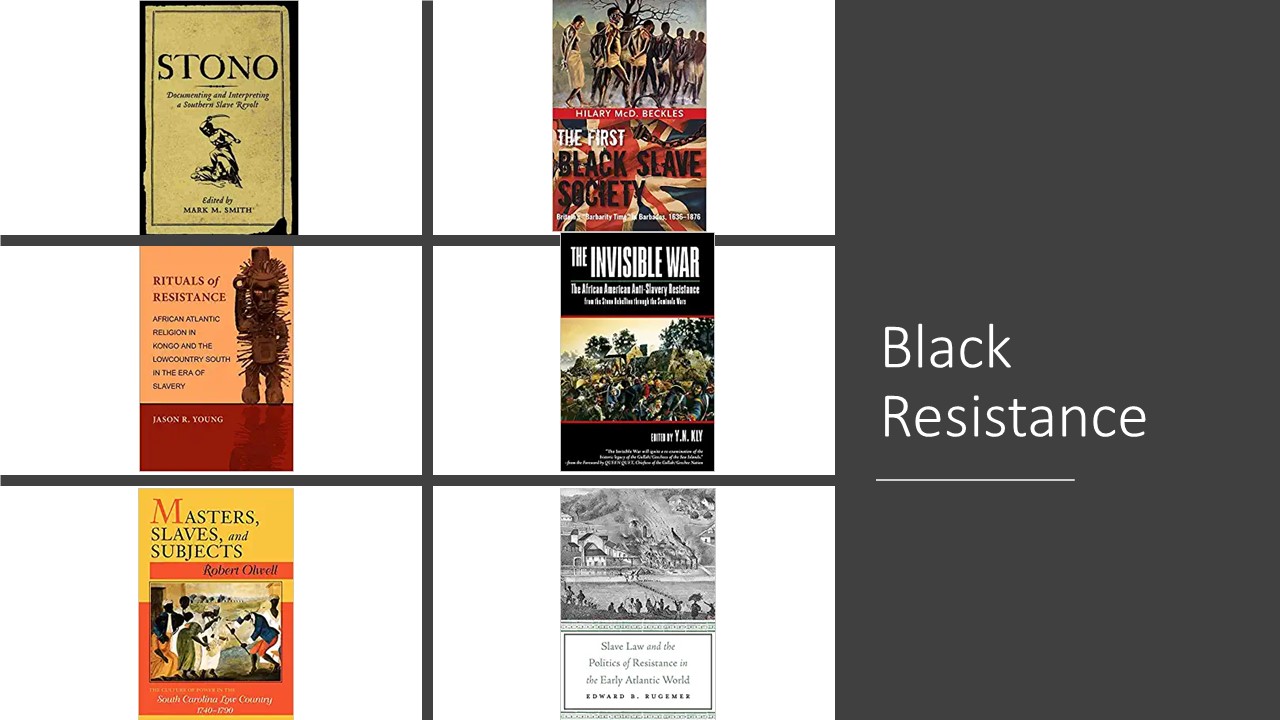
February 1: "Black History Note Wednesday:" You will notice a theme in my FB posts on Wednesdays this month. First up: Slave Law and the Politics of Resistance in the Early Atlantic World by Edward Rugemer (2018) compares the development of slavery in Jamaica, Barbados and South Carolina and how some individuals resisted the systems used to keep them enslaved. The BDC has a copy in our Research Room and there is one copy you can borrow through the SCLENDS consortium with your library card.

February 3: Today's "Finding Aids Friday" features a small collection of correspondence relating to a bold resister to the South's peculiar institution. I am referring to the man with guts of steel, Robert Smalls. As most of you know Smalls steamed the Planter into the Union's naval line under the nose of the Confederates in Charleston Harbor in 1862. Though the man and his feat were nationally famous during the Civil War and Reconstruction eras, Dorothy Sterling (1913-2008) was the first author in the 20th century to take note of the significance of the act and of the man. She wrote a book for young adults entitled Captain of the Planter: The Story of Robert Smalls (1958). We have letters between Sterling and Beaufort Township Library staff from 1955 to 1956 in the Research Room. Sterling was doing her due diligence trying to separate fact from fiction and reconcile conflicting accounts of some of the details of Smalls' life. Sterling's book was well received. The Research Room and a few other reference collections in the SCLENDS consortium have a copy of her published book. Her book has been reprinted at least twice so far. The Dorothy Sterling Letters Finding Aid is in the BDCBCL: Lists, Links and Finding Aids blog.

February 7: Beaufort County's own Thomas Barnwell of Hilton Head Island is featured as the February 2023 honoree in the SC African American History Calendar. Be sure to watch the video that the calendar has posted about this man who personifies non-violent Black Resistance to economic, political, and social inequities. Long a friend to the special collections department, we have his History in Development, 1972 -- and Wild Horse Court Phase II... that deal with affordable housing on Hilton Head Island; The Fishing Co-op Role in the BASF Conflict and the popular Gullah Days: Hilton Head Island Before the Bridge that he co-wrote with Emory Campbell and Carolyn Grant.


February 8:
 "Black History Note Wednesday: Black Resistance" - I am allowed to collect materials about broader South Carolina history when I determine that a particular item helps to provide context for Beaufort District's more specific local history. Though the Stono Rebellion occurred in what is now Charleston County, it scared the beejezus out of the planters who owned slaves - and hardened their planters' hearts against any attempts at resistance. The laws governing the enslaved were tightened; the behavior of the whites in charge tightened against Black persons in the state.

Peter H. Wood wrote a groundbreaking thesis in 1972 that was turned into a monograph in 1975 entitled Black Majority : Negroes in Colonial South Carolina from 1670 through the Stono Rebellion. It has remained in print ever since. Wood explored the consequences of importing the largest single group of non-English-speaking migrants to the North American colonies on United States history through a thorough and penetrating case study of the Palmetto State during the period. He ends it with the Stono Rebellion of 1739 and its aftermath. The BDC has a copy but there are also plenty of copies that you can check out through the SCLENDS consortium.

February 13: "Materials Monday : Uniquely BDC" - The Denmark Vesey Affair was an important example of Black Resistance to the shackles of enslavement and Black Codes of the antebellum period. The BDC has the only original published copy of An official report of the trials of sundry Negroes : charged with an attempt to raise an insurrection in the state of South Carolina: preceded by an introduction and narrative; and in an appendix, a report of the trials of four white persons on indictments for attempting to excite slaves to insurrection (1822) in the SCLENDS consortium. (19th century book publishers loved descriptive - and long - title/subtitle combinations.) Learn about the trial and its consequences in our Research Room: bdc@bcgov.net; 843-255-6468.

February 15: "Black History Note Wednesday: Black Resistance" A more contemporary version of the Trial of Sundry Negroes ... mentioned here on Monday is Designs Against Charleston by Edward Pearson (1999). On July 2, 1822, officials in Charleston, South Carolina, executed a free black carpenter named Denmark Vesey for planning what would have been the most extensive slave revolt in U.S. history. Pearson provides a fascinating and comprehensive account of the Vesey conspiracy that uses both primary and secondary sources including the words of the accused. Plenty of copies of this title are available for check out from the SCLENDS consortium. If you really want to read up, check out the other items on the flyer too.

February 22: "Black History Note Wednesday: Black Resistance" - Author Robert Olwell examines how colonial slave societies were different than the "Old South" early 19th century one which most of us are more familiar in the aptly titled Masters, Slaves and Subjects. The book jacket states: "In this study of a colonial older South, [he] analyzes the structures and internal dynamics of a world in which both masters and slaves were also imperial subjects. While slavery was peculiar within a democratic republic, it was an integral and seldom questioned part of the eighteenth-century British empire. [Olwell] examines the complex relations among masters, slaves, metropolitan institutions, officials, and ideas in the South Carolina low country from the end of the Stono Rebellion through the chaos of the American Revolution. He details the interstices of power and resistance in four key sites of the colonial social order: the criminal law and the slave court; conversion and communion in the established church; market relations and the marketplace; and patriarchy and the plantation great house." The Research Room has a copy but you can also borrow one from other parts of the SCLENDS consortium.

February 23: Robert Smalls, arguably Beaufort District's most famous native son, died in his sleep at his home at 511 Prince Street in Beaufort on February 23, 1915 according to his death certificate. He was survived by his two daughters, Elizabeth Lydia Smalls Bampfield, Sarah Voorhees Smalls Williams, a son, William Robert Wigg Smalls, and a number of grandchildren.


February 24: "Finding Aid Friday" - Today's selection results from the process of trying to find an appropriate topic for Black History Month and preparing a Finding Aid for it. We have a folder simply labeled in my predecessor's hand "Robert Smalls" that has been stored in Box 2 of the Miscellaneous small collections for some time. I figured since Smalls had died on February 23rd, a Finding Aids post about the contents of the "Robert Smalls" folder in Box 2 of the Miscellaneous collections boxes would be an easy choice for Finding Aid Friday on February 24th. I was wrong. So while there is no actual Finding Aid to share today, in the course of doing the archival processing work, I came across an article that I think may interest you: The Savannah Tribune account of the funeral of Robert Smalls. It was published on page 1 of the newspaper's March 6, 1915 issue.

According to the newspaper article all of Beaufort attended his funeral on Friday, February 26, 1915. Five Black ministers eulogized Smalls. The choir sang "Shall We Meet Beyond the River" as people paid their respects at the last viewing of the body. With the music of the Allen's Brass Band leading the cortege, members of Masonic Lodge, Sons of Beaufort, No. 36 and the Odd Fellows Lodge No. 2211 carried the body through the streets to the Tabernacle Baptist Churchyard where Smalls was laid to rest with "a most impressive Masonic ceremony.... The funeral was the largest ever held in this city." Floral arrangements were numerous but those sent by the City Council and the Grand Army of the Republic were praised in particular. His survivors were listed as daughters Elizabeth Smalls Bampfield of Beaufort and Sarah Smalls Washington of Orangeburg and a son, W. Robert Smalls of Austin, Texas and several grand children.

Olivia and I will be happy to set up an appointment for you to come to review this or other materials in the Research Room: bdc@bcgov.net or 843-255-6468. JSYK: I plan to write a Connections post about the about the challenges of getting intellectual control, making archival collections more accessible, and reuniting disparate deposits into one archival collection. My goal is to write and finalize a Hillary S. Barnwell Research Papers Finding Aid by the end of March - just in time to close out Women's History Month.

February 26: One of the things that I like most about working in the Research Room is learning new "stuff" from BDC customers. One recent inquiry falls into the "Black Resistance" theme for this year's Black History Month celebration. A history professor at a college in Maine had stumbled across a local newspaper article in which an elderly Black woman claimed to be an escaped slave from Beaufort, SC. After sharing what he'd already tried to see if he could document aspects of the article, he asked for some guidance, The rest of the story is in [this] Connections [post].

February 27: "Materials Monday: Uniquely BDC" - The Invisible War: The African American Anti-Slavery Resistance from the Stono Rebellion through the Seminole Wars, edited by Y.N. Kly contains 6 articles that together challenges the notion that there was no collective resistance to slavery among the enslaved peoples. Indeed, the authors contend that the error arises from the lack of awareness of African American who self-liberated southward towards Georgia and Florida. The only copies of this title in the SCLENDS consortium are in the Beaufort County Library's special BDC and Gullah Geechee reference collections.

February 28: Books in the BDC with a "Black Resistance" theme to round out Black History Month posts:

Local History Programs:

February 2 (AM): Olivia and I are looking forward to seeing all those with tickets at the lecture today .... Reservations become null and void at 10:55 AM. We open the empty seats to those who may be standing by at 5 minutes before scheduled program start time.

February 2 (PM): What an excellent "Historically Speaking" program today. Thank you Colonel Baxley for sharing your knowledge of local military history as it relates to the Battle of Port Royal Island. Expect to hear more about the American Revolution in Beaufort District in the coming months and years.

February 3: We booked all seats in advance but because of "no shows" we were able to seat folks on stand by this time. I've just added more photos that Olivia Santos and Mary Lou Brewton took of the "Battle of Port Royal Island, 1779" local history program yesterday. To see all the photos: Select Photos > Albums > Battle of Port Royal Island with Neil Baxley.

February 6: "Materials Monday: Uniquely BDC" - In honor of our most recent "Historically Speaking" series program, today's selection is First American Victory of the British Southern Campaign, February 3, 1779 : Battle of Beaufort (38BU2336), Beaufort County, South Carolina : March 21, 2020. Daniel E. Battle discovered the site in 2016. The report is quite lavishly illustrated with 149 Figures. He also gave us the print of the battle that now hangs in our Research Room. Give us a call or shoot us an email to set up an appointment to make a research visit: bdc@bcgov.net; 843-255-6468.

February 21: One month to the next Beaufort History Museum/Beaufort County Library local history program: Shrimp Tales: Small Bites of History Author Book Talk by Beverly Jennings. Registration will open on March 7th through the Beaufort History Museum's website.

Finding Aids Friday: 

February 10: "Finding Aid Friday" --... and just in time for Valentine's Day! Mae Onthank of Seabrook, SC wrote letters to her fiancée, Billy MacLeod chronicling her life, activities, and plans for their wedding in June 1915. Many of the letters bespeak of matters of the heart such as:

* July 18, 1914 - Darling I love you to death - Crazy 'bout you - Your Maezie
* October 20, 1914 - Dearest Boy: ... You know I love you too much and I think you were made for me and I had never thought that the war would make any difference with our marrying each other. Write and tell me about it. Do you really think it will? I hope and pray it will be best for us to get married in June.
They discussed guest lists, food, venues, honeymoon plans, etc. - all those things that brides and grooms have discussed since weddings became a "thing." The letters end right before their wedding held in the St. Helena Episcopal Church in late June 1915. There's also plenty of information about daily activities, family, friends, business, illnesses, etc. in northern Beaufort County.
The donor of the Onthank Letters collection, Mae and Billy's descendant Douglas C. MacLeod, put together 3 volumes of transcriptions of some of the letters, added family photographs such as the one shown of Mae Onthank, and wrote introductions explaining the family and social relationships. The transcriptions are bound in book form and housed in the shelves with call numbers SC 929.2 ONT vol. 1, SC 929.2 ONT vol. 2, and SC 929.2 ONT vol. 3. Because the letters themselves are rather fragile, customers are encouraged to use the transcriptions whenever possible to minimize further damage to the correspondence originals.
Mae and Billy would rear a family in Lynchburg, VA and remained married until their deaths. He died in 1979; she in 1983. They are buried in the Spring Hill Cemetery there.

February 17:
"Finding Aid Friday:" Today's featured archival collection is the Crofut Diaries. Ellen Augusta Chapman Crofut (Mrs. James M. Crofut) kept a daily diary for most of her adult life. She took note of the weather, family news, and social affairs particularly with extended members of the Onthank Family and at the St. Helena Episcopal Church in Beaufort, SC. There are 31 diaries and 1 folder of loose materials, clippings, and items found in the diaries. If you're on the Library's email distribution list, you already know that she wrote about President Grant's visit on New Year's Day 1880. If you've read Connections, then you know that she wrote about the 1886 Earthquake and aftershocks for several weeks. If you've watched my "Tide of Death" presentation, then you know how disappointed I was that she wrote very, very little about the biggest natural disaster to yet befall Beaufort County, the Hurricane of 1893. I am grateful, though, that she kept social and musical programs for souvenirs attached or loose in her diaries.
The Finding Aid is posted on the BDCBCL: Lists, Links and Finding Aids blog.

Special Events:

February 4: Stuart's Town Symposium highlights with photos and video

February 11: There's a party going on at Beaufort Branch this morning, 10 am - Noon. I put together a small display in the BDC's Lobby Board downstairs to commemorate the building of the Beaufort Library extension of 1992/1993 that most residents and visitors think of as the "30 year old" Beaufort Branch Library. The "new" 30-year old Beaufort County Library at 311 Scott Street is simply the most recent iteration of library services delivery from the nexus of Carteret, Scott, Craven and Port Republic streets in downtown Beaufort. There's more in the Connections post of 7 February 2023.

February 16: The Beaufort International Film Festival reminds me that folks are always interested in movies made in Beaufort County. Follow the links to get additional information about the feature films.

For the good of the whole:

February 9: Public Service Announcement: As in years past, volunteers are in some of the Library's facilities to help you with tax preparation on certain days at specific times. The Tax Help page on the Library's website points you to the most current and up-to-date information about tax preparation volunteers and services.

Schedule adjustment announcements were made on February 12 and 17.

25 February 2021

Recap of Black History Month 2021


If you happen to be on Facebook and if you happen to follow the BDC's Facebook page, then you know that posts related to local African American history, people, places, and events are made frequently every month of the year. 


In fact, every Wednesday that the Library is open, I make at least one "Black History Note" (BHN) post. During February 2021, my Wednesday Black History Notes featured materials that the BDC shares about the role of religion in African American life and culture.

Here's a recap of the BHNs I made on Facebook this month: 

3 February 2021
- Religion is a powerful force within most African-American communities. In May 1940, Zora Neale Hurston recorded a 15 minute documentary film of religious services taking place at Commandment Keeper Church in Beaufort South Carolina. In 2005, her film was selected for the United States National Film Registry by the Library of Congress as being 'culturally, historically, or aesthetically significant'. 
 
You can see Commandment Keeper Church on the Pioneers of African-American Cinema disc 5. The BDC has one that can only be watched inside our Research Room but Beaufort Branch has a copy of the DVD that cardholders can check out and watch at home. We also have a vertical file about the film and a vertical file for Hurston here in the Research Room. 
 
If you'd like to learn more about this amazing African-American author, playwright, and dynamically outspoken woman, watch "Literature to Life: Zora!, ~ 20 minutes adaption of the theatrical biography of her life by Laurence Holder. 
 
10 February 2021It would be hard to overestimate the power of the church in the African American experience in the United States. ETV's star, Professor Henry Louis Gates, Jr., explores the 400-year-old story of the black church in America, the changing nature of worship spaces, and the men and women who shepherded them from the pulpit, the choir loft, and church pews. You can watch "The Black Church: This Is Our Story, This Is Our Song" four-hour, two-part series on SCETV on February 16 and February 23 at 9 pm. [You can check out the book upon which the series is based.]
 
17 February 2021
-
Continuing on the theme of Black Churches, Slave Missions and the Black Church in the Antebellum South by Janet Duitsman Cornelius (1999) concentrates on the fruitful period in the 1840s and 1850s when evangelization efforts among the enslaved allowed Black people to recreate Western Christianity in such a way that African ritual and practices, European rites, Holy Scripture, and musical forms became distinctly the foundation of the Black Church that endures to this day. Among the Beaufort District area churches mentioned in the narrative are Robertville's Black Swamp Baptist Church, Tabernacle Baptist Church, Grace AME Church, and Brick Church.
 
24 February 2021 - Sometimes PhD dissertations end up as published books. Such was the case for The Abundant Life Prevails by Michael Charles Wolfe. 
 
The BDC has a printed and bound copy of his approved dissertation presented to the Graduate Faculty of the University of Virginia in May 1997 and the book of the same title published by Baylor University Press in 2000. 

Rev. Wolfe is an ordained Methodist minister who examined the collision on St. Helena Island of the religious style adapted by the enslaved with roots in Southern evangelicalism and African traditions with the religious styles of Reconstruction era Protestant Northern missionaries like Laura Towne, William Channing Gannett, Ellen Murray and Harriet Ware. Because this book is based on religious traditions of St. Helena Island, we have a reference copy in the BDC as well as in the Local History sections at the Branch Libraries for you to borrow.
 
The Materials Monday posts in February also featured African-American letters in the BDC. 
 
1 February 2021 - Corp. James Henry Gooding, a 26 year old member of Company C, 54th Massachusetts Volunteers, United States Colored Troops, wrote of his arrival at Port Royal on June 3, 1863:
Messrs. Editors:

-- After a long passage of seven days, we have arrived at Port Royal. We are still on board the vessel, and I write my first letter on the top of my knapsack, with one of the loudest noises around me ever heard, and heat enough to make a fellow contemplate the place prepared for the ungodly. There is nothing interesting to write as yet, for the very good reason that we have none of us been ashore. I write this letter to let the friends of the men know that we are all safe, except one, who jumped overboard the first night out from Boston. I think that he must have been cracked or drunk, more likely the latter. The men are all in good health and spirits, not one man in the whole regiment being now on the sick list. After we are quartered on shore, and have an opportunity to look around, you may expect better letters. -- J.H.G.
And indeed, Gooding wrote about 50 weekly letters to his local newspaper, becoming "a truthful and
intelligent correspondent" (in the words of its Editors) for the staunchly abolitionist New Bedford (MA) Mercury newspaper. Eminent Civil War historian, James McPherson, describes Gooding as "observant, well informed,a fluent writer, passionately committed to the cause of Union, liberty, and black rights. He also possessed a sense of humor that makes these letters a delight as well as an education to read." The letters are one of the few known collections of materials by a United States Colored Troops soldier about USCT military actions and conditions. His eloquence helped persuade the Congress to provide equal pay for Black soldiers in 1864.
 
Gooding enlisted in the Union Army (though he had sea-experience from working on whaling vessels) on Valentine's Day 1863, seeing action in South Carolina including the assault on Fort Wagner, in Georgia, and in Florida where he was wounded in the thigh and captured in the Battle of Olustee. He died in Andersonville Prison on July 19, 1864.
 
The only copy of this title within SCLENDS is in the Research Room. 
 
8 February 2021
- [Today's post] features a letter of congratulations on July 27, 2014 from Bishop Richard Franklin Norris to the Grace Chapel African Methodist Episcopal Church congregation.
The letter begins the church's "145th Year Commemorative Journal." Bishop Norris and Mary Ann Norris wrote: 
"This critically important gather of your history is an important undertaking for your church and for our Zion as we continually remember the sacrifices and the contributions made by Richard Allen and other leaders in establishing our church. This is an incredible milestone, and one that the church can reflect back on thankfulness and gratefulness to God who has steered us over the years....You offer a strong witness for the African Methodist Episcopal Church far and near."
The Research Room has almost 100 vertical files about Beaufort District's "Churches", including one about Grace Chapel. We'll be happy to show any - or even all 2500+ of the BDC vertical files to you - by appointment.
 
The Library was closed for Presidents Day on February 15th. 
 
22 February 2021 -One of the major sources for African American military service records are pension records. Securing one for yourself or by your survivors can entail a great deal of paperwork - and documentary evidence. 
 
Thanks to the Heritage Library, we have copies of They Served: Stories of United States Colored Troops from Hilton Head Island, South Carolina compiled and edited by Nancy Burke, Patricia Burke, and Susie Marquis (2017). It includes transcriptions of pension files of Black soldiers who served during the Civil War. 

Among the men who sought pensions was Renty Miller. Miller had been a Black soldier who served in Company G, 21st Regiment, USCT from August 23, 1864 to April 25, 1866. Miller could read and write (albeit with some phonetic spelling like many others in the late 19th and early 20th centuries). He set up a side business as a scribe to other former soldiers on the island. He would write the Pension Commission Office on their behalf. However, in the letter dated August 16, 1916 shown in the image, Renty Miller asks about his own pension payment. 
 
Dear Pension Commission Sir
I have Rote this few line for to ask you when my increse will commence. I have see all of the boys that is belong to the Same Regmeant have reseaved their increase and I having get mine same I have Rote to you for to find out sumthing about it. Please to oblig me to give me answer. Yours truly, Renty Miller, Co. G 21 Regt.
 
The Pension Commission Office registered receipt of Miller's letter three days later. His pension was increased to $21.50 a few days after that on August 23, 1916. At the time of his death, his USCT pension was $50.00 per month. 
 
We have copies of They Served in the Research Room and more that can be checked out from the Local History sections at the Branch Libraries.
 
Other African-American related posts made on Facebook in honor of Black History Month 2021 were about Dr. Brent Morris's lecture on Reconstruction; an online webinar with Amy Murrell Taylor, author of Embattled Freedom, a recently donated religious revival flyer from 1963, Robert Smalls, Missionary Teachers to the Freedmen, other African-American related posts here in Connections, and Turner's seminal work on the Gullah language 
 
I trust that you will agree that the BDC honored some of the many significant contributions of African Americans to Beaufort District's long and storied history this month.