Showing posts with label Summer Reading. Show all posts

09 June 2024

Finding "Adventure" in the BDC

As regular readers know, I always try to "fit" in something from the BDC during a Library system initiative. Such was the case again this year during the Summer Reading Program. Since it's all about "Adventure," I began by looking up the definition of the word. According to the online Cambridge English Dictionary, adventure is "an unusual, exciting, and possibly dangerous activity, such as a trip or experience, or the excitement produced by such an activity." Sounds exciting, doesn't it? But where could I find "adventure" lurking in the BDC's stacks? How could the BDC offer some "adventure" in our programming in June and July? What adventuresome materials should we bring to our readers' attention in the display case, the lobby board, on social media, through our programs? 

I started thinking about what we have and could perhaps do months and months ago. In here, pretty much everything starts with a search: of the catalog, or the archives inventory, or the dark recesses of my brain. Over the course of the next two months, you'll see the results. Because the BCL likes for programs to be added to the system calendar no less than 4 months in advance, thinking about local history programs coordination is normally a first step activity. 

I was glad that Deb Henderson asked me about doing something - and that I discovered a PowerPoint I created about a decade ago with lots of images and some research about the Bluffton Branch.


Editing prior work is almost invariably less intensive than crafting a presentation from scratch. The result will be "Then & Now, Bluffton Library Services: An Adventure Through Time" on Saturday, June 22nd at Bluffton Branch Library. Lecture begins at 11 AM.  I'll take care of the "then" part; Debra will handle the "now" part. We hope that attendees will learn a little history and learn something new about the library services currently available to our cardholders. 

Since Cassandra's probationary period will end soon, I asked her about devising a presentation of what she's learned so far as our contribution to SRP 2024. We decided to call her session "Adventures in the Archives ... OR BDC Treasures I've Found my first 6 months on the job."  This session is for "True History Nerds" who love research materials! 

We decided to give an evening session a try since the best attended "Behind-the-Scenes" event was on a Wednesday evening. Please note: This is not a rehash of the BTS events. She's been working on a number of projects since January so her presentation will consist of mostly "new-to-us stuff" she's discovered or re-discovered as she works through our decades long backlog of archival materials. We'll be happy to have you join us. I really think that you'll be impressed by how much she cares and enjoys working with the "stuff" here in the special collections and archives unit. This session will be in the Beaufort Branch Meeting Room, 311 Scott Street, 1st floor on Wednesday, July 24, 2024 beginning at 5:30 PM.  

A chance encounter at the Institute for the Study of the Reconstruction Era Symposium in April led directly to our third program related to the SRP.  Meg Gaillard and Reese Spradley of the Heritage Trust of SC DNR just happened to have the booth next to ours. In the course of casual conversation, it turned out that Meg would be doing some doctoral research at Fort Frederick the last weeks in July and it's been more than a decade since I last took BDC history nerds to that historic site. Another adventure we could share with you was born! Please note: Transportation to Fort Frederick is on your own. Parking at and near Fort Frederick is limited so consider carpooling. 

With Jalen's departure, I will once again take over the display case for a bit since I'd rather have Cassi fill in at the front desk on a regular basis. I can also get at least double mileage - and perhaps triple or quadruple mileage -  from that work. I'd have to research "adventure" in the BDC for the display case and then I can use that "adventure" research to create Facebook posts for the "Uniquely BDC: Materials Monday" and "Black History Note Wednesdays" series and perhaps for a few other dates in June and July as well. The triple factor will come in if I manage to find some interesting facets to add to the lobby display board down by the elevator on the first floor; the quadruple factor will be if I can create some slides from this work to show on the Vizio monitor in the 2nd floor reception area over Ileana's desk. 

I guess only time will tell whether or not the BDC is successful in our adventuresome endeavor. You can be the judge come the end of Summer Reading 2024.

11 June 2023

"All Together Now" BDC Program #1: Africans in South Carolina

This year's Summer Reading theme "All Together Now" is meant to bring us all together no matter of our age, socio-economic status, political affiliation or physical location. As library employees we were tasked with coming up with a program or two for adult audiences related to local history that touched on the theme. Bluffton Branch Reference Librarian Debra Henderson suggested that we explore the historical demographics of our state in a program at her branch library.  

One fact that a lot of people misunderstand about the history and demographics of South Carolina is how decisions made before the year 1700 have resounded through all the ensuing years. We hope that those who attend our next local history program leave having a better understanding of our state's unique colonial and post-Revolutionary War history. 

As one of the original thirteen colonies, South Carolina possesses a rich heritage of African American history because of decisions made in Europe beginning in the 16th century that carried over into the settling of South Carolina and its later history. Africans first arrived in the Lowcountry with the Spanish in 1526. When the English Lords Proprietors established control over the land that would later become South Carolina in 1670, they immediately encouraged settlers to purchase and enslave Native Americans and Africans to carve settlements out of the wilderness. Rather quickly, Africans of diverse origins comprised about 20% of the colony's population. Because enslaved people became the colony's major labor force, by 1720 Africans outnumbered white settlers. 

By 1740, African Americans made up two thirds of South Carolina’s population, many of whom had first landed at the Sullivan's Island Quarantine Station in Charleston Harbor. That year also marked two firsts in South Carolina:  the enactment of a more comprehensive slave code in the wake of the Stono Rebellion (1739) and the enactment of a law curtailing the slave trade. 

Though the Stono Rebellion occurred in what is now Charleston County, it scared the beejezus out of the planters who owned slaves - and hardened their planters' hearts against any attempts at resistance. The laws governing the enslaved were tightened; the behavior of the whites in charge tightened against Black persons in the state.
Peter H. Wood wrote a groundbreaking thesis in 1972 that was turned into a monograph in 1975 entitled Black Majority : Negroes in Colonial South Carolina from 1670 through the Stono Rebellion has remained in print ever since. Wood explored the consequences of importing the largest single group of non-English-speaking migrants to the North American colonies on United States history through a thorough and penetrating case study of the Palmetto State during the period. He ends it with the Stono Rebellion of 1739 and its aftermath. We highly recommend Wood's book as a key source explaining these early years in the colony.

In spite of the change in importation law, over 58,000 Africans were imported into the colony between 1750 and 1775, the highest number for any of the North American mainland colonies. After 1750 the majority of these imported enslaved people were from the West African areas of Senagambia and Sierra Leone who brought along their skills at rice cultivation, a major cash crop of the colony.

Consequently, imported Africans and their descendants were critical to the development of the area's society and economy. Africans also played a critical role in the Revolutionary War. Join us to learn about African life and activity in in the Lowcountry from 1526 to 1790 from African-American Studies Professor, Meldon Hollis, Jr..  


About Professor Hollis: 

Mr. Hollis has held senior governmental positions at the municipal, State, and Federal levels. He has served as vice president for University Relations at Texas Southern University and as a university administrator at Harvard and the University of Maryland at College Park. He has taught on the faculty of Northeastern University, the University of Maryland, Howard University and as a visiting professor at Savannah State University. 
Over a 35-year work history, he has served in the Army Security Agency; as special assistant to the Assistant Secretary for Education in the Department of Health, Education, and Welfare; as director of the White House Initiative on HBCUs; as an attorney; and as a business consultant. In 1965, while enlisted in the Army, Mr. Hollis received a Presidential nomination to and attended the United States Military Academy at West Point. 

Mr. Hollis holds an M.A. in government and politics from the University of Maryland at College Park, and a J.D. and M.P.A. from Harvard University. He has studied international law and indigenous courts at the University of Legon in Ghana, West Africa.
He currently serves on the Board of Directors of the Hilton Head Island Gullah Museum.  
Saturday, June 24, 2023 - "African Presence in the Lowcountry" with Meldon Hollis, Professor of African American History | 10 AM - Noon | BDC@ Bluffton Branch Library, 120 Palmetto Way
Debra and I hope to see you soon! (And if you do attend, you can mark off the "Participate in a Library Event" block on your SRP 2023 Bingo Card!) 
A heads up: 

04 June 2023

Olivia Santos' "Favorites" Display: Part Two

Before Olivia moves, I asked her to create another Favorites display of materials she has discovered in the Research Room during her stay.  She told me that she used the marine life cloth as background because it was the liveliest one that I have stockpiled here - and that most of the book covers of her favorites were not particularly lively. She was looking for some contrast to catch the eyes of our in-room researchers and you readers of Connections. Here are the explanations of why she choose what she choose. -- gmc 

June is finally here, and it is once again time to test my Midwestern blood against the heat and humidity of a South Carolina summer. I’d like to say I’ve gotten used to it, but to tell you the truth I don’t think I ever will. However, I will definitely miss those warm winters as I pack up and head back to Illinois.

With my partner getting out of the Navy and starting school, we are moving back to the Midwest come July (or at least that’s the plan). Grace and I are both sad that I’m leaving, and I have been lucky to meet so many lovely folks during my time here, both within the BDC and outside of it. So, as a follow-up to my December [2022] post about my favorite books in our collection, this post will be a part two that includes my favorites, as well as materials we have that I simply think are interesting and worth talking about with you all.

I actually did have some sort of planning in terms of organization this time, although Shelf 1 is the only shelf that doesn’t have much of a theme beyond ‘general history that I find interesting.’ I chose to include The Death Care Industry: African American Cemeteries and Funeral Homes by Roberta Hughes Wright and Wilbur B. Hughes III (2007) and Carolina’s Lost Colony: Stuarts Town and the Struggle for Survival in Early South Carolina by Peter N. Moore (2022).

The Death Care Industry, being over 600 pages long, has a lot to say. Focusing on a variety of locations in South Carolina and beyond, the book discusses specific cemeteries that many locals are familiar with, such as Beaufort National Cemetery and Coffin Point Cemetery. Besides discussing the general history, this book goes a step further by highlighting burial practices, folktales, cemetery preservation and restoration, as well as discussing the impact slavery has had on these industries. Overall, this book has a wide scope with helpful and informational content. We often get questions about cemeteries with folks doing genealogical research, so I like to refer back to this book every once in a while. It may be weird to some people that this was my first pick for my ‘favorites’ list, as it can be a bit of a morbid topic, but I’ve always been fascinated by the death care industry and cemeteries as a whole, and this book continued to pique my interest. The BDC currently houses the only copy of this book within the Beaufort County Library system and SCLENDS.
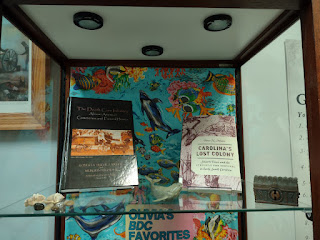
Carolina’s Lost Colony is one of our newer books, coming to the research room right around the time of the Stuarts Town symposium hosted at USCB back in February, although there are now multiple copies available for checkout within the SCLENDS consortium. Examining the Scottish and Yamasee habitation of Port Royal in the 17th century, this book gives a great run down of early colonial history in South Carolina among both its native peoples and the colonizers who later came to this land. We were waiting for this book to hit our shelves for a while in anticipation of the symposium, which brought in a lot of people also interested in the topic and the dig being done to find evidence of Stuarts Town’s location. Carolina’s Lost Colony is also special to me in the sense that one of the archeologists working on the Stuarts Town dig, who also spoke at the symposium, allowed me to come with her on a dig back in March to learn the ropes and help out with her graduate school research out at Mackey Point Plantation.

If you’re interested in learning more about her work, check out her profile on the University of Michigan’s website.
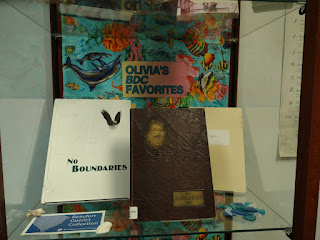
Shelf 2 is dedicated to school annuals. Yearbooks might seem like a random choice, but to me they are some of the most interesting materials we have in our collection. Many people may not realize this, but a majority of our collection has been donated to us by various persons and organizations over the years. We do buy plenty of our own books, of course, but yearbooks are special in that they can only be procured by donation; the schools do not send us a free copy every year or anything like that. So, I decided to showcase our oldest and most recent annuals from Beaufort High School: 1921, 1937, and 2007. Many of our yearbooks contain signatures, handwritten notes, drawings, and the like, which adds a personal touch to these materials and gives those of the modern age a better sense of the lives and times of these teenagers that were sitting in classrooms over 15 years ago as well as over 100 years ago. Naturally, we are the only institution within the consortium or library system that houses these materials.
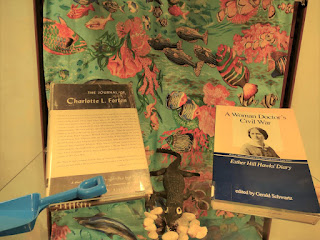
Shelf 3 features stories of inspiring women, particularly during the Civil War era: The Journals of Charlotte Forten Grimke by Charlotte L. Forten (1988) and A Woman Doctor’s Civil War: The Diary of Esther Hill Hawks by Esther Hill Hawks (1984).

Taking place over the course of ten years before and during the height of the Civil War, Charlotte Forten’s journals serve as a snapshot of America’s past. A Black woman growing up in a prominent anti-slavery household in Philadelphia, she spent much of her life during the years this journal was written teaching freed people in South Carolina, particularly at the Penn School as its first Black teacher. The contents of her journals are similar to a book I featured in my last ‘favorite things’ post in December: A Black Woman’s Civil War Memoirs by Susie King Taylor (1988). But while Taylor only touches on the discrimination and racism she experienced minutely towards the end of her book, Grimke expands on the subject and her own personal experiences much more. Oftentimes, the accounts we have of this time period lean heavily toward the stories of the white men in high society. It’s not only valuable to have Grimke’s own personal accounts for history’s sake, but also because she provides a point of view that is rare from this time period, as she was both Black and a woman. And if you ever come into the research room asking for materials on Reconstruction, more than likely I’ll end up bringing out both Grimke’s and Hawks’ books.

Unlike Grimke, Esther Hill Hawks was a white woman who came to the South as a physician during the Civil War. Written between 1862 and 1866, her diaries cover her times in the sea islands, as well as in Charleston and Florida. Like Grimke, she also taught freedmen, and talks in great detail about her travels to educate and treat folks affected by the Civil War. Grimke and Hawks break from the status quo for women of the time period by advocating for and supporting those being oppressed by the institution of slavery that was so prevalent during this time, and as a result cared for and educated countless folks who otherwise would have continued to be ignored.

Both books can be found throughout the SCLENDS consortium or are available inside the BDC.
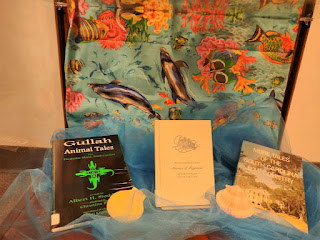
Shelf 4 showcases some of the collections of stories and legends I’ve come across in our collection: More Tales of the South Carolina Lowcountry by Nancy Rhyne (1984), Gullah Animal Tales from Daufuskie Island, South Carolina by Albert H. Stoddard (1995) and Betty Stringfellow’s Stories and Legends of John’s Island, South Carolina by Elizabeth H. Stringfellow (2004). From ghost stories to tales and legends, all three books are a bit more lighthearted than the others featured in this case. Many are oral histories that have been passed down among families and communities that have finally been written down, although occasionally with a supernatural twist. I find books like these a nice break in the sometimes dense and technical language our books can have, taking a more lighthearted approach to real world people and events (or not real). I also think stories and legends are a great way to get a closer look at a community or culture, such as how Gullah Animal Tales features the stories in their native Gullah tongue, as well as translations in standard English. Betty Stringfellow’s book is only available for viewing here at the BDC, but Gullah Animal Tales and More Tales of the South Carolina Lowcountry are available for checkout in a variety of locations within our library system and SCLENDS.

This is Grace again. I will offer that should you like "To Read About the Lowcountry" (column 2; line 5) for the Library system's "All Together Now" Summer Reading Program 2023 that most of the titles Olivia has written about would be excellent choices. I don't think that "reading" a high school annual would qualify - but hey, that's just a personal opinion.  

PS: You can read all about the Summer Reading Program on the Library's website and download a game card to participate. You could also double-down - read one book and count it towards both the Library's official SRP 2023 and use it for the American Historical Association's 2023 Summer Reading Challenge as well. I am. I think getting to "use" something more than once is a highly efficient way to read or create. 

Summer Reading Programs for You!

2023 is a year for Summer Reading Program options. In fact, I am going to tell you about 2 SRPs in this post. 

1) As is customary, the Beaufort County Library is sponsoring a Summer Reading Program this year. It runs two months: June 1 through July 31. You're always invited to participate! There's no registration. You can either pick up a paper game board at your favorite Branch Library or download and print one yourself.  The Adult readers SRP has been around BCL for about a decade or so now. Whatever you want to read is fine for the purposes of participation. Plus there are some family programs and even two local history programs geared towards adults to pick from to help check off blocks on the game boards. So I recommend that you participate in the Library's traditional SRP. I will. 

But let's say that you are of a particularly history-related bent of mind. (I'd say that that conclusion isn't much of a stretch since you're reading my local history related blog at the moment.) Well, as it turns out the American Historical Association is in its 2nd year running its own Summer Reading Challenge. (I missed it last year). It's also easy-peasy: Read one history non-fiction "item" per month (yes, journal articles or even a book chapter each count as 1 item) in June, July and August. You get a bit longer to finish the AHA SRC: It begins June 1 but runs about 5 weeks longer that the Library's customary SRP. In other words, you have until Labor Day, Monday, September 4, 2023 to get the reading all done. You can use the Bingo card pictured here to guide you to select three items in a row or column. If you're like me, the challenge is limiting myself to only 3 items. 
Just based on book recommendation flyers I've made in the past 3 or so years, I can offer you lots of local history titles to consider. Here are three flyers to get you started: 

On May 2nd we offered the Jackpot program with Jason Ryan. I distributed copies of this flyer at that local history program. If you enjoy true crime stories, the Library has a number of titles to share. (Carnival of Blood is by far my favorite title for a true crime book). 

At the "Liberty Trail" presentation with Bill Davies, I distributed copies of some recommended reading about the course of the American Revolution in South Carolina. Just by reading the three American Revolution related chapters in Dr. Rowland's The History of Beaufort County, South Carolina, 1514-1860 you could complete the AHA SRC. 

I had copies of this flyer available for attendees at "Dueling in Beaufort District" with Neil Baxley on May 24th. 

BTW: The items with +hoopla means that the SCLENDS consortium has printed copies and that there is an electronic copy and/or audio book of the title on the Library's Hoopla digital collection. If you have a Beaufort County Library card, you can easily set up an account at start borrowing e-books, audio books, listening to music, watching television shows or movies. The details are found on the Library's Hoopla landing page.

In case you're wondering, I always try to have flyers or displays relating to the local history topic du jour at all BDC sponsored programs. So expect another post after Professor Hollis' June 24th presentation and yet another after Nathan Betcher's talk about Reconstruction Era politics on July 12th. I even have some suggestions for my August 22nd presentation about the Hurricane of 1893 to share.

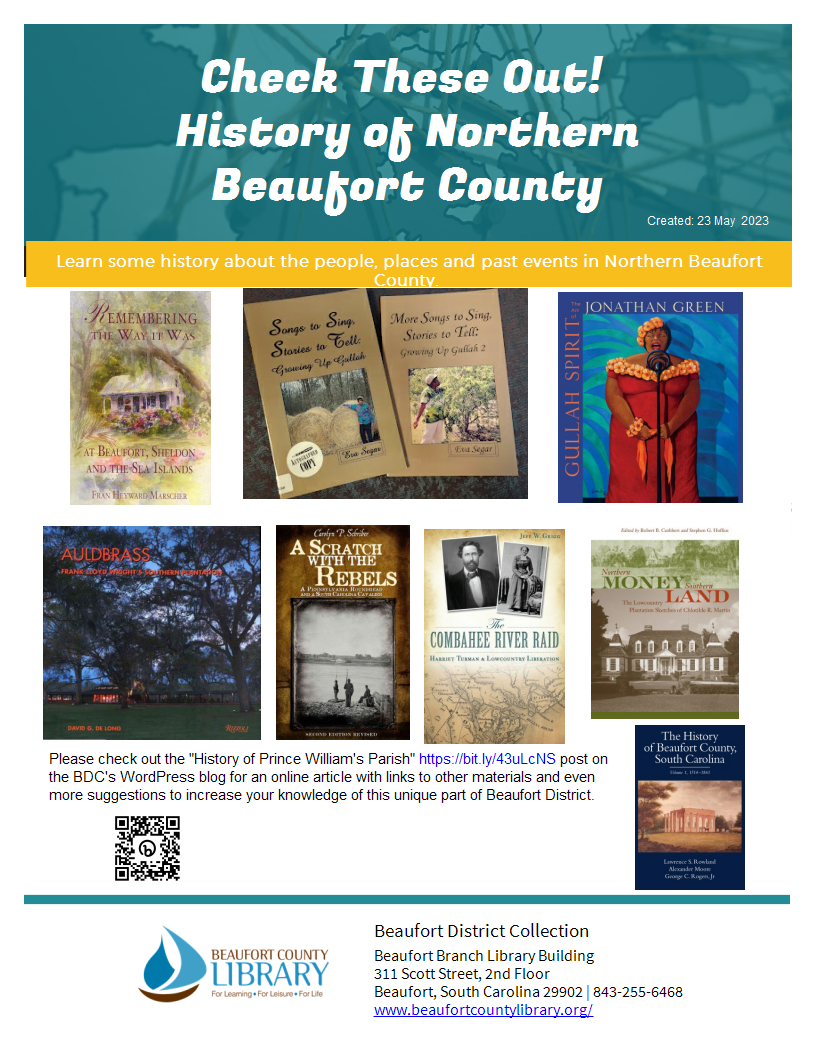
And hot off the Grace Press is a list of recommended materials about the history of Northern Beaufort County that I created in honor of Lobeco Branch Library's 20th birthday. 

In other words, there are boocoodles of local history titles to read and enjoy over the next several months. 

At the end of the summer, AHA Reads runs through Labor Day, we might be able to do an online discussion of what we've individually and collectively read for the AHA Summer Reading Challenge 2023. Let me know if you're interested: 843-255-6468 or bdc@bcgov.net.  

07 August 2022

June and July 2022 BDC Facebook Posts

As you have learned, I am to reduce social media posts by 66% over the course of the Performance review period that runs from April 1, 2022 - March 31, 2023. I have had some difficulty cutting things down since that went into effect but as the posts below indicate, I am getting some better at it. Without doubt, I will exceed that dictum - and do more than the 200 required posts -- but I seriously doubt that I will ever get close to 700 posts in a year again. Here are the posts I made or scheduled to appear during June and July.  

JUNE 2022 

June 1 - Overview of the months of June and July in the BDC:
The Library system offers "Oceans of Possibilities" during the 2022 Summer Reading Program. You can expect to see some promotion of "salty" materials from the BDC this month and next.
I am thrilled to announce the return of Doug Bostick, Executive Director of the South Carolina Battleground Preservation Trust for our annual "Carolina Day" lecture on June 28th. The Beaufort County Historical Society and the BDC are co-sponsoring the event.
No local history programs are planned for July though there is a historical marker unveiling at the Carnegie Library building on July 7th that you might want to attend.
The Library system will be closed on Monday, July 4th for the Independence holiday.

June 2 - I am going to 'The Search for Stuarts Town' Free Kick-Off Event Monday, June 6, 2022 10:00 AM 12:00 PM and perhaps you should too! (BTW: I'm stealing this notice from the BCHS)
The public is invited to the kick-off of this community archaeological project that will happen, LITERALLY, in our own backyard! Join us on June 6th from 10AM to noon at Morrall City Park on Craven Street to get the “inside view” from local experts Dr. Larry Rowland and Dr. Chester DePratter, and Mr. Adam King, Director of USC’s SC Institute of Archaeology & Anthropology. A demo of the archaeological digging process will be provided and The St. Andrews Society of the Lowcountry, SC will be on hand, clad in their Scottish regalia, with light refreshments.

June 3 - Today is World Bicycle Day. In its honor I share an historical tidbit that I came across while reviewing the clippings in the "Merchants" vertical file on behalf of an off-site BDC customer awhile back. From the "Palmetto Post" newspaper of 4 October 1900, [p.2]: "It is estimated that there are 500 bicycles in Beaufort, and only one first class repair shop. The business ought to pay handsomely." (I just love the Palmetto Post's slogan.)


June 6 - "Materials Monday: 50 Shades of Beige" in honor of the kickoff for a new archaeological project: Map #239 [Scotts Settlement or Stuart Town 1682 - 1686] is a reproduction of a map rediscovered in the British Museum in 1971. Local historian John Morrall wrote an article for the Beaufort Gazette published on 29 July 1971 on page 3-B explaining his reasoning for stating that the Stuart Town colony was likely along Hermitage Road.
I think that the editor - like me - doesn't want to get involved in any arguments so the article begins with "(Editor's Note: The following has been submitted to the Beaufort Gazette by John Morrall, a well known Beaufortonian and highly respected historian. Anyone who has any questions concerning the following information is asked by Mr. Morrall to contact him at P. O. Drawer 498, Beaufort, S.C.)"

The article is among others in the STUART TOWN COLONY vertical file in the Research Room.
The goal of the "Search for Stuarts Town" archaeological shovel test being demonstrated today at the project kickoff in (appropriately named) Morrall Park on Craven Street from 10 AM to Noon is to ascertain information that might lead to the discovery of the exact location of Stuart Town - which remains in doubt.

June 6 - Great turnout at the Search for Stuarts Town Kick-off this morning. I was privileged to be among my "tribe" and sitting next to Mr. Robert DeLoach who designed the BDC's HVAC system more than a decade ago. Lead archaeologist Dr. Chester DePratter was explaining what archaeologist Hannah was doing to the crowd. (I support the study of archaeology professionally and with BDC programs, personally make a point to visit archaeological sites on my free time, but no way would I want to practice their profession.)

June 7 - My 4 year old grandson is fascinated by sharks and whales. During his recent visit he told me all about the various species. The BDC has sufficient material about local sharks but not so much about whales. A desire to impress my grandson was a key reason why I went to the St. Helena Branch Library's SC Aquarium's presentation on 4 June to gather some more information in hopes of sounding a tad more knowledgeable about whales and sharks the next time he and I What's App. The Aquarium folks didn't say much about sharks but I did learn that a Cuvier's beaked whale can dive almost 2 miles below the surface of the ocean. Can't wait to tell Aidan! (Cuvier's beaked whale photo by Ed Corey, Brian Patterson, Andrew Rapp, Seabirding customers)
June 8 - "Black History Note:" The Family Tree Magazine announced its "Best African American Genealogy Websites" list recently. Be sure to explore all the offerings but particularly the wonderful resources curated by genealogy guru Toni Carrier hosted on the International African American Museum's Center for Family History website.

June 8 - The Spring 2022 issue of the Jewish Historical Society of South Carolina magazine features Beaufort's Jewish families: the Levins; the Keyserlings; the Scheins; the Lipsitzs; the Marks; the Neidich/Rudowitzes; and the Youngs, the Beth Israel Congregation, and a few images from the BDC's holdings. We have a copy in the Research Room for permanent safekeeping.
BTW: The JHSSC will meet in Beaufort this weekend, June 10 - 12. Contact Enid Idelsohn idelsohne@cofc.edu or 843-953-3918 for details regarding conference program details, schedule and fees. [Note: This event has passed.]

June 9 - During my absence, my "Diversify Your Reading" choice for May was published in the Connections blog If you just want the meat: The most classic of Beaufort District related titles, Rehearsal for Reconstruction: The Port Royal Experiment by Willie Lee Rose (1964) was my "History" choice.

June 9 - Well it's hurricane season again and the predictions are for another active season. I watched with some trepidation a Pacific cyclone end up off shore of South Carolina last weekend. Are you ready? Neil Baxley, head of Beaufort County Emergency Management is presenting "Are You Ready?" at various library branches. Check the Library's events calendar for details. Looking ahead: I'll be doing my most popular presentation "Tide of Death: The Great Sea Island Hurricane of 1893" at Bluffton Branch on the anniversary of the storm. Live and in-person ...

June 10 - FamilyTree Magazine named the South Carolina Digital Library as one of its 75 Best State Websites. Did you know that some of the BDC's resources are hosted on the SCDL website courtesy of our long partnership with the Lowcountry Digital Library? See images from the American Civil War to the mid-20th century. View postcards. Read a surgeon's journal and accounts of the 1893 hurricane. Access all 1750 items (so far) that the BDC staff and beloved docents have labored to share digitally with our customers, locally, nationally and internationally.

June 12 - According to FB, this is when most of you actually read my posts. Learn about what was "New and (New to Us) in the BDC for March and April 2022".

June 13 - Oysters and the lowcountry just go together. so the "Materials Monday : 50 Shades of Beige" series will have a briny focus the next few weeks. I will share a few beige hued items in the Research Room that are about oysters. First up: Read Burrell's South Carolina Oyster Industry: A History in the Research Room by advance appointment, borrow Bluffton Branch Library's local history copy or read it online.

June 14
- A lot of flags have waved over this area in the past as one of my favorite local history books of all time indicates in its title. Port Royal Under Six Flags by Katharine M. Jones is an oldie-but-goodie book first published in 1960. She included letters and notices and other primary documentation for the Spanish, Scots, English, Confederate, and Federal periods, mostly focusing on people who lived during those times. It helped plant the seeds for my future career as both a degreed librarian and ACA certified archivist with post-graduate study in American and African-American history at UNC-CH. (Other major influences that I remember from elementary school days: Ben and Me by Robert Lawson and Johnny Tremain by Esther Forbes.) (Seeing the beginning of a pattern here?) The Library has plenty of copies of Port Royal Under Six Flags to share.

June 14 - Registration for the "Legacy of Carolina Day" lecture by the Executive Director of the SC Battlefield Trust, Doug Bostick on Tuesday, June 28, 2022 at 11 AM has opened. Space is limited. Please note: This lecture is being held in the Fellowship Hall of the First Presbyterian Church of Beaufort, 1201 North Street at 11 AM. Registration closes when capacity is reached. This in-person only program is brought to you by the BDC and Beaufort County Historical Society as lecture #4 of the 2021 - 2022 "Historically Speaking" series.

June 15 - "Black History Note:" Photographer Jack Leigh celebrates the African American men and women who made Oystering: A Way of Life before it passed into history. When he took the photos between 1979 and 1981 before his eyes the traditions were being lost. Pictured hard at work on the water and in the canneries are Beaufort County residents Fred Walker, Joseph Heyward, Joseph Pinckney Sr. and Jr., Sam Bennett, Nealy Fripp, Annie Mae Gadsen, Henrietta Kitty, and William Lawton.

June 16 - Family Tree Magazine selected the South Carolina Department of Archives and History website as one of the nation's best. I think that the index is geared more towards genealogists than historians and can take some patience to work through all the variations in names and spellings. That written, it is one of my "go-to" suggestions for any family historian. Search the index to names in wills, records of Confederate veterans, criminal court records and other sources - many of which you can view in their full glory.

June 17 - Only a few seats remain for Doug Bostick's lecture about the "Legacy of Carolina Day."

June 17 - I run across all sorts of interesting "things" while on the hunt for my customers - and sometimes I am struck by how everything old eventually becomes new again seeing as human nature seldom alters very much. Case in point, I came across the following statement in a MARC record created by Brenda Beasley-Forrest about a particular title we have in the BDC. She quoted the author of the source in the MARC record: "Manipulation, fearmongering, intolerance, elitism, arrogance, greed, deceit, slander, hatred, inhumanity, exploitation, unbridled ambition, and mercenary self-interest--all are inimical character traits . . . found in three recent biographies of ..."
Select the best answer - for you.
A) Randolph Murdaughs Sr., Jr., and III
B) Presidents Biden, Trump and Obama
C) early South Carolina religious leaders: Alexander Garden, Oliver Hart, and Archibald Simpson
Just to be clear - Ms. Beasley-Forrest was only quoting the author of the material and I am responsible for creating 2 of the 3 options above - but which 2? And I hope that you will chuckle at the irony ... I'll provide the answer from the MARC record a few days from now.

June 20 - A federal document is today's "Materials Monday : 50 Shades of Beige" selection. If you were interested in marine crustaceans it could put you in heaven but me, not so much. (JSYK: A special collections librarian doesn't have to like everything in a collection - the item just has to meet the collections development rubric and be affordable). It is a tri-colored beige item entitled Annotated Bibliography on the Fishing Industry and Biology of the Blue Crab, Callinectes sapdius by Marlin E. Gazatz and Ann Bowman Hall, NOAA Technical Report NMFS SSRF-640 (1971). JSYK: The cover looks a lot more beige in person than in the photograph - and the pages are definitely creamier in person.
June 21 - And the answer is to the Quiz Time post on 6/17/22 is: "Manipulation, fearmongering, intolerance, elitism, arrogance, greed, deceit, slander, hatred, inhumanity, exploitation, unbridled ambition, and mercenary self-interest--all are inimical character traits . . . found in three recent biographies of C) early South Carolina religious leaders: Alexander Garden (Anglican), Oliver Hart (Baptist), and Archibald Simpson (Presbyterian). The MARC record goes on to quote: "Promoting their respective Christian denominations throughout the colony . . . sparked volatile contests over membership and power, both between and within religious denominations. It likewise fueled fiery debates among clergymen concerning conversion methods and the proper role of the church in shaping individual congregants along with the larger society." Source : The Library's catalog record for the South Carolina Historical Magazine : July 2018, Volume 119, Number 4, page [251].

June 21 - Connections has a new post: The "Thriller" selections for June as part of the "Diversify Your Reading Challenge."

June 22 - "Black History Note:" Oystering was traditionally a part of the Gullah lifestyle. In addition to the book Oystering that I wrote about last week, the BDC has an inscribed poster of the book cover's in our holdings. This poster from 1983 is part of a collection of 200+ posters of local events and activities that we have in the Research Room. Titles of the posters are listed in the Library's catalog. Photodocumentarian Jack Leigh inscribed this poster "To Julie" - who was actually Julie Zachowski, the Director of the BCL from 1973 to 2003.

June 23 - Just in case you're interested in the rascals named in the post on 6/21/2022, the Library has more materials about Rev. Oliver Hart, Rev. Archibald Simpson, and the Alexander Garden, an Anglican priest who lived between 1686 - 1756 to share with you. There are chapters about Oliver Hart in both Saints of Clay by Louise Owens and A History of South Carolina Baptists by Joe King. We have two biographies about Rev. Alexander Garden: one by Hawkins (1981) and the other by Witzig (2018) and the 2 volumes of the Rev. Simpson's diaries, 1754-1784. Just be sure to make the necessary appointment: 843-255-6468 or bdc@bcgov.net.
June 24 - In keeping with the "Oceans of Possibilities" Summer Reading Program theme of 2022: My favorite sea creature is the dolphin. Did you know that the dolphins off Hilton Head Island have unique characteristics? Check out Dolphins of Hilton Head from one of the BCL's Local History sections to learn more.

June 26 - Pencil this into calendar: The Library will be closed on Independence Day. If you want to come to the Research Room between Wednesday, June 29th and July 8th, now would be a good time to make those arrangements with me: bdc@bcgov.net ; 843-255-6468.

June 27
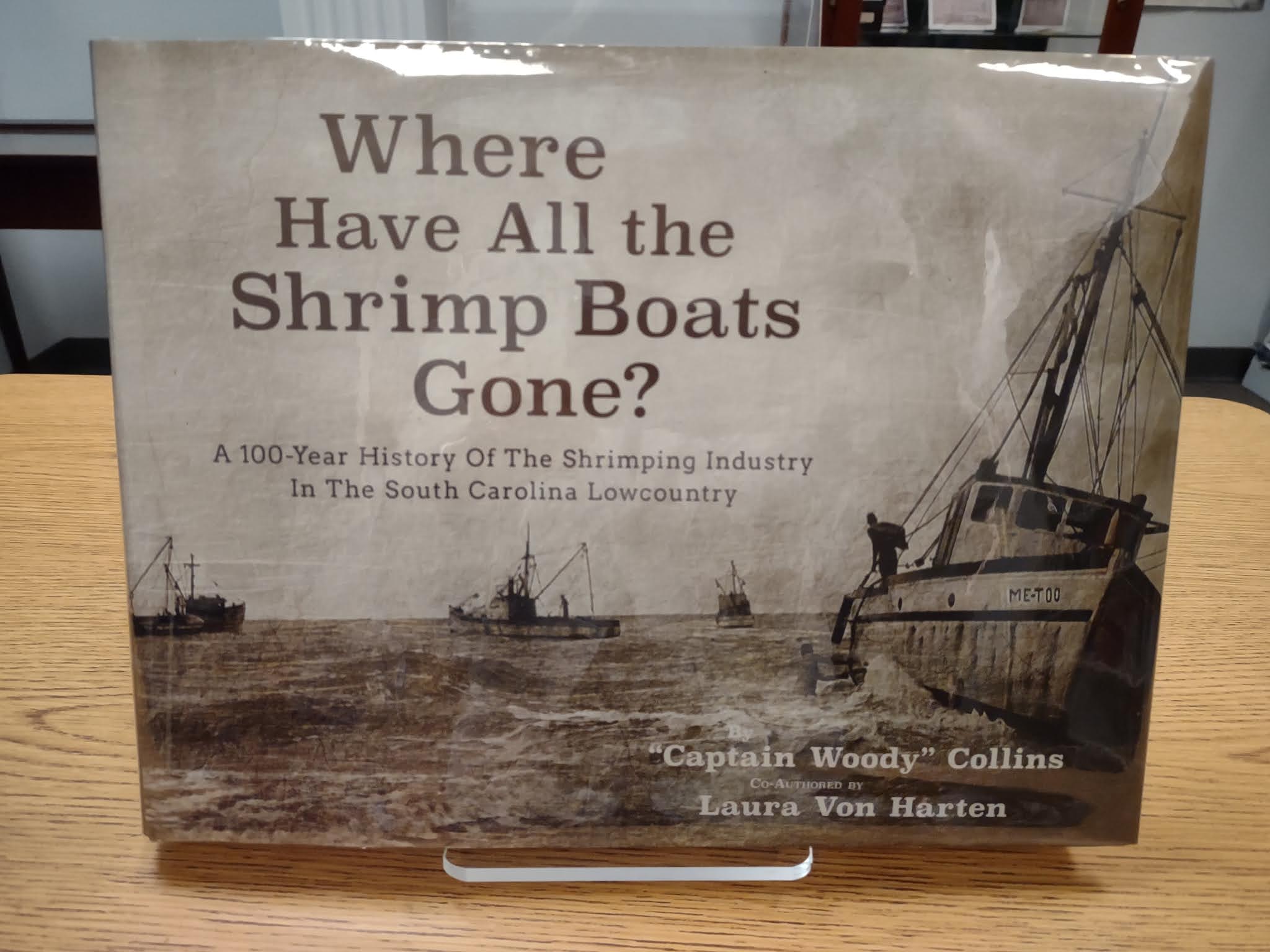
- "50 Shades of Beige: Materials Monday:" A healthy ocean is necessary to grow tasty shrimp. Learn about the history of the commercial shrimping industry of this area in Where Have All the Shrimp Boats Gone? by Capt. Woody Collins. We have copies of the book at the Branch Libraries Local History sections for you to check out. Captain Woody was very gracious and gave the BDC inscribed, signed and numbered copies for permanent retention.

June 28 - I do so hope that you got a seat reserved for today's "Historically Speaking" Carolina Day 2022 program before they were all taken. I'll be there to learn -- and hawk the materials and services of the BDC to the assembled group. Please note: This is an in-person only local history program. JSYK: Most local history programs "sell out" within a few days once registration opens - and we have a great 2022-2023 roster for you! Details will be announced soon.

June 28 - We had another "sold out" "Historically Speaking" local history program with our partner, the Beaufort County Historical Society. Doug Bostick, Executive Director of the SC Battlefield Preservation Trust, got us all up to date about the Liberty Trail and highlighted the Patriot victory at the Battle of Sullivan's Island that we natives celebrate on Carolina Day.

June 29 - "Black History Note:" The Fishermen of the Lowcountry : Memories from Home features African American crabbers, shrimpers, and oystermen of the upper South Carolina coast. The BDC has the only copy in the BCL because of its beautiful depiction in images of one aspect of the Gullah way of life. There are a few copies you can borrow through the SCLENDS consortium.

June 29 - Looking ahead: If you want to come to the Research Room on or before July 8th, now would be a good time to make those arrangements with me: bdc@bcgov.net ; 843-255-6468.

June 30 - Lowcountry marine creatures are fascinating. Follow the link to an updated oldie-but-goodie post about a special type of shrimp.

June 30 - I "stole" a wonderful post from the SC Battleground Preservation Trust about South Carolina's Signers of the Declaration of Independence for Connections.

JULY 2022

July 1 - Didn't get a reservation to the "Historically Speaking" lecture on Tuesday? Never fear. The Library offers titles by presenter Doug Bostick to increase your knowledge of South Carolina history.

July 1 - Reminder: All units of the Library will be closed on Monday, July 4th. Regular hours resume Tuesday, July 6th.

July 2 - A momentous day in the history of South Carolina: No doubt that the Beaufort District slaveowners were watching ... and waiting. Learn more about Denmark Vesey.

July 3 - In honor of our country's 246th birthday, I "borrowed" this post from an email I received from the South Carolina Battlefield Preservation Trust in 2020. Enjoy! (PS: Don't forget that the Library is closed on Monday, July 4th).

July 4 - Closing notice

July 5 - The Beaufort County Historical Society loves for the public to attend historic marker installations. As is the case for many of the BCHS Historic Markers, much of the research began in our very own Research Room - and of course, this particular dedication is part of our Library's own story.

July 5 - There's still time for you to participate in Hampton County's Historical Marker Hunt. (For those of you who don't know, all of Hampton County was once part of Beaufort District. It became a separate county in 1878). Details.

July 6 - "Black History Note:" Ocean views offer an "ocean of possibilities" for generating profits for some real estate developers. The Land was Ours: How Black Beaches Became White Wealth in the Coastal South by Andrew W. Kahrl (2016) documents the interrelationship between coastal economic development beginning in the mid-20th century and the dispossession of traditional African American landowners along the southeast and Gulf coasts. Hilton Head Island and St. Helena Island Branch libraries have a circulating copy of this title that you can borrow.

July 6 - New entry on Connections: This time the briny materials on display in the BDC.

July 7 - I hope to see at least a few of you around 11 AM today at the Historic Marker dedication. If you miss it or don't live in this area, you can read about the Beaufort Township Library's history on the BCL's website.

July 8 - The Association for State and Local History 2022 conference theme concentrates on the "Power of Place." The BDC has some "power of place" themed items. For example, Margaret Rushton's local history projects with the 6 - 8th grades at Lady's Island Middle and Beaufort Middle Schools and the Essence of Beaufort & the Lowcountry volume were all about the power of place. What it means to be here : Palmetto Bluff, Bluffton, the Lowcountry and beyond : the photography of Marge Agin and Bluffton State of Mind are all about the draw of the southern reaches of Beaufort County. Copies are in the BDC and in the local history sections at the Branch Libraries.

July 8 - I begin FMLA on Monday, July 11th. I have scheduled the Materials Monday and Black History Note posts in advance so no one has to be completely devoid of BDC historical notes and tidbits.

July 11 - "50 Shades of Beige: Materials Monday:" Of Sand and Sea : Teachings from the Southeastern Shoreline was published by the S.C. Seagrant Consortium in 2000. The booklet examines the physical features and marine life of the Ocean Planet as well as issues affecting its fragile marine environment. The title is available inside the Research Room for those who have made an appointment, you can use your BCL library card to borrow the item from another SCLENDS library or you can just read it online.

July 13 - "Black History Note:" 200 years ago a former enslaved Black preacher, Denmark Vesey, was convicted and executed (on July 2, 1822) for conspiring to foment a slave insurrection in nearby Charleston. The conspiracy to revolt was purportedly set for July 14th in honor of the storming of the Bastille in France during its Revolution. All of South Carolina's white residents were distressed by the events. The BDC has the only original published copy of An official report of the trials of sundry Negroes : charged with an attempt to raise an insurrection in the state of South Carolina: preceded by an introduction and narrative; and in an appendix, a report of the trials of four white persons on indictments for attempting to excite slaves to insurrection (1822) in the SCLENDS consortium and several secondary works about the trial and its consequences for you to increase your knowledge of this key antebellum event. The SCLENDS consortium and Hoopla have even more...

July 17 - Check out the latest content on Connections.

July 18 - "50 Shades of Beige: Materials Monday": Sallie Ann Robinson has released 3 cookbooks so far and the first one, Gullah Home Cooking, the Daufuskie Way (2003) featured a number of recipes featuring fish, crab, shrimp and oysters. The BCL has plenty of copies in the Local History sections to share. Whip up some "Daufuskie Catfish and Shrimp Mull" (p. 64) for your next gathering.

July 20 - "Black History Note Wednesday:" One of the hazards inherent in the obituary card files is the opportunity for misfiling. For example, earlier this summer I had a customer interested in the Stewart Family. Amid the obituaries for Stewart Family members was this card relating to the death of the teenaged son of a local Black law enforcement officer due to unspecified causes, but likely a disease of some sort. Because SC didn't require death certificates until the 1910s, we likely won't ever know what killed young Sandy. I have returned the card to its proper place in the obituary card files. Sandy B. Colonel is the only Colonel family member in our Online Obituary Index.


July 25 - "50 Shades of Beige: Materials Monday": A Guide to Saltwater Sport Fishing in South Carolina was published by the South Carolina Wildlife and Marine Resources Department in 1973. The photos of mostly fishermen triumphant with their catches are a real blast to the past.

July 27 - "Black History Note:" WEBE Gullah/Geechee : Cultural Capital & Collaboration Anthology compiled and edited by Queen Quet Marquetta L. Goodwine (2015) includes 3 essays that fall within the Oceans of Possibilities theme: "Culture interrupted: a brief overview of the history and state of Gullah/Geechee fishing" by Dr. Jamelle Ellis; "Gullah/Geechee subsistence fishing economies: under threat from gentrification" by Dr. Annette Watson; and "Protecting Coastal Communities of color through understanding the Federal Environmental Justice Executive Order and Title VI of the Civil Rights Act of 1964" by Attorney Chandra T. Taylor. There are reference copies of this title in the BDC and in the St. Helena Branch Library. The State Library has one copy that can be checked out by BCL library cardholders.

July 31 - Check out the latest content on Connections.