Showing posts with label library history. Show all posts

07 April 2024

Assistant Librarian Mackenzie, 1861 by Sue Mackenzie Thornton

I am embarrassed to say that this article courtesy of Sue Mackenzie Thornton has been sitting in my computer files for more than a few years. I've been long meaning to share it at an appropriate time - and given that it's Library Week 2024 - I shall do so today. It's an unknown story - and if the 79th Highlanders re-enactors return to the Beaufort History Museum during my remaining tenure, I'll have something "new to us" to highlight. Some of you may quibble about the differences in the source materials when it comes to the man's name. As any experienced family historian can attest, variations in name must be weighed against other sources to decide whether or not Lochlan McKinsey is the same person as Loughlin Mackenzie is the same person as Lachlan Mackenzie. Standardization in the spelling of personal names is more of an 20th century practice than a 19th century one.

Lachlan Mackenzie (1838-1864), Civil War Beaufort Librarian by Sue Mackenzie Thornton, edited by Jake Thornton (2017?) 

Allan Mackenzie, a Scottish immigrant, and his wife Maria Martling had ten childrenFour of their sons, and two of their sons-in-law joined the 79th New York Highlanders Infantry during the Civil WarOne of these sons, Lachlan would spend some time in the Beaufort Library
Following is his roster obtained from The New York Military Museum and Veterans Research Center.

His regimental return for December 1861 contained a puzzle. What was a soldier doing serving as an assistant librarian?


A call to Grace Morris Cordial, manager of the Beaufort Collection at the library helped solve the puzzle. The New York Public Library, Irma and Paul Milstein Division as well as online research provided further pieces for the puzzle.

When the Union occupied Beaufort on November 7, 1861, they took control of everything including the library. The following excerpt from The Life of Isaac Ingalls Stevens by his Son Hazard Stevens, Volume II, pp. 367-368 provides some details.


Brigadier General Stevens of the 79th Highlanders opened the library to his soldiers and intended to care for it, returning the books to Beaufort after the conclusion of the war. So Lachlan participated in Steven's plan to both protect the books and lend them to the men. But as the rest of the Stevens excerpt indicates, he was overruled and the books were seized. 

A New York City auction of the Beaufort books was met with many negative editorials such as the following in the November 14, 1862 New York Evening Post. The New York Public Library, Milstein Division provided this newspaper article as well as the subsequent one. 

But the tale of the books took a positive turn. The Beaufort Collection history available on the Beaufort Library website quotes from Frank Leslie's Illustrated Weekly that a letter from New Yorker William H. Fry to President Lincoln was instrumental in having Treasury Secretary Salmon P. Chase cancel the sale. Newspaper editorials such as this one probably also aided cancellation efforts. 

This November 22, 1862 Cincinnati Commercial Tribune article, a reprint of a November 5th New York Times article, records the escape of Beaufort's books from the auction block. The collection was sent to the Smithsonian Institute for safe storage. 

In February 1865, Harper's Weekly published this January 24, 1865 Alexander Gardner photo which is available at the Smithsonian Archives. 
The photo above illustrates the negative twist that occurred next in the Beaufort Library story, as an incorrectly installed stove on the second floor of The Smithsonian caused a fire which spread to the upper room housing the collection and all the books were burned.  

Lachlan Mackenzie whose military record supplied the puzzle at the beginning of this story, remained with the 79th until the end of his life, dying of Typhoid Fever in a Knoxville, Tennessee hospital on November 27, 1864.  

Lachlan is buried at Knoxville National Cemetery and his gravestone was created in March 1864 by 79th officer Hugh Young and his fellow stone masons.  

I wonder if Lachlan helped compile the auction list for the book sale that never happened. You can see a facsimile of that auction catalog on one of the Behind-the-Scenes tours we're hosting in honor of National Library Week. Check for any remaining slots by calling us: 843-255-6468. 

There is a lot more information about the Mackenzie brothers and their Civil War in the BDC's HISTORY-CIVIL WAR, 1861-1865-PERSONAL NARRATIVES - UNION vertical file. We have accounts from Charles Francis Adams, Clover Adams, Harrison M. Beardsley, James Bell, John Bell, Ephraim Bender, Norris Crossman, Robert Sedgwick Edwards, Harriet Ward Foote, John Frederic Holahan, William H. Johnson, George H. Johnston, Louis Kelsey, Charles Phineas Lord, Laughlin Mackenzie, Dr. Seth Rogers, Calvin Shedd, Stephen Minot Weld, Gottlieb Schahl, and some unknown correspondents.  

It'd be optimal if you make an appointment to come review the contents of the file and the other Civil War related vertical files that we make available inside our small facility: 843-255-6468; bdc@bcgov.net.

07 February 2023

Happy Birthday, Beaufort Branch Library

The Library system decided to "celebrate Library birthdays" as part of a continuing series of events to engage the public and showcase library services. Sounds like fun, doesn't it? Pretty much every human alive wants a sugar rush that cake supplies - and to eat some at their local beloved library, super cool, right? Picking a date seems simple enough too: What day did the current Library building begin providing library services to its community? Or perhaps, When was the current Library building dedicated? Hopefully the two dates - dates of service delivery and the dedication date - would be fairly close together. Here's the problem when this principle is applied to the downtown Beaufort Branch Library:

The structure supplying current services was cobbled to an older structure and the 1st and 2nd floors of the new construction were finished years apart. The "new" building was providing services from part of its structure 6 months before the building was dedicated. The day that library service delivery restarted after everything was put on new or relocated shelves in part of the partially completed building - got more text - and a better photo -- in the Beaufort Gazette than coverage of actual the Dedication Ceremony. (Longtime Beaufort Gazette reporter - and longtime Friend of the Beaufort Library supporter - Lolita Huckaby wrote both the re-opening and the dedication articles.)

From reviewing the contents of the Beaufort County Library archive that we have in the Research Room, I learned a few things.

1) There are no BCL photographs of the Dedication ceremonies of 1993. None. Absolutely nada.

2) Library Director Julie Zachowski had a hard slog trying to get a more appropriately sized structure approved, sited, built and opened.

3) The building took a long time to plan, build, and finish -- almost as long as the 9 years and 16 days it took me to get the BDC Research Room moved from the First floor to out of the flood plain on the Second floor of this building at 311 Scott Street.

From the records found in the Research Room, it seems that the Beaufort County Council argued with the Library Board of Trustees, Library Director, and construction entities, etc. for years from the time of official recognition that the 1964 library was no longer suitable for the growing population of the area to walking into a completely finished Library building with an entrance address of 311 Scott Street in 1998.

  • To save money, the 1980s-1990s extension connected to the Craven Street Library (built in 1964) on the ground floor. The 1964 library became the Children's services area in 1992.
  • Most of the first floor extension was opened to serve the public on August 24, 1992.
  • Construction of the first floor was completely finished in October 1992. They waited until the multiple layers of stain on the SC Room shelves finally dried and the landscaping was installed to pronounce the first floor done.
  • The Library Board of Trustees and the Friends of the Beaufort Library decided that the formal Dedication ceremony would happen on Valentine's Day, 1993 - hence the source of the "30th Birthday" theme on Saturday at Beaufort Branch.
  • Construction on the 2nd floor would be delayed due to cost and political considerations. It was completed in 1998. At that time the second floor was Library Administration offices and a large meeting space.
  • In 2009-2010 that large meeting was converted to house the growing the Beaufort District Collection.

Looking ahead: Because the BDC is its own cost center, has its own policies, keeps its own hours, and does "its own thing" in accord with public library and archival principles and practices, the BDC's "Birthday Celebration" will be at the end of September commemorating the move from the vastly overcrowded conditions of the area now occupied by the Beaufort Branch Theresa Dunn Meeting Room to the former Paul S. Siegmund Meeting Room on the second floor. We'll be celebrating 13 years of service from our current location. But as you will learn, what started out as a shelf in the Carnegie Library, grew into a closet, then into a room, and then into a much larger room. Library services related to local history go way further back in time. More details will be announced closer to the BDC's relocation celebration.

The display that I put in the lobby panel near the elevator on the first floor of the Beaufort Branch Library tells the basic story behind this Saturday's "Beaufort Branch 30th Birthday" event. The lobby board features some surrogates of construction photographs, a newspaper image, the dedication invitation, and a slide that summarizes construction costs and size. I added the floating sparkling hearts because it's February and February is Library Lovers Month.

Bottom (and last) line: This Library location has seen a lot of changes in the past 59 years.

25 January 2021

Smithsonian Fire Destroys Beaufort's Libraries

When the Union captured Beaufort in November 1861, it also captured the contents of the Beaufort Library Society that were stored at Beaufort College as well as the personal libraries of many Beaufort residents. An auction was scheduled for November 17, 1862 but Lincoln's Treasury Secretary Salmon P. Chase declared "The Union does not make war on libraries" and stopped it. Secretary of War Edwin Stanton -- whose original order to sell the books had started the controversy -- removed the books to the Smithsonian Institution in January of 1863.

Two years later, on January 25, 1865, the Beaufort Libraries collection burned when a stove started a fire in the South Tower of the Smithsonian Institution. Though it was an accident, the damage was not easily undone. Indeed, the confiscation of the town's library materials by the Union occupying forces and the accidental destruction of the materials was a sore spot for more than 75 years.  
 
South Carolina Congressmen and Senators brought the issue up regularly on Capitol Hill.  The situation particularly annoyed Mabel Runnette, Head Librarian of the Township Library, who kept steady pressure on state and federal lawmakers for almost 20 years beginning in 1930. Runnette and many of the Board members felt that the Federal government should either replace the burned books or give the Beaufort Township Library adequate compensation for the loss incurred by the community during the Civil War. 
 
U.S. Representative Clara Gooding McMillan, a middle-aged widow rearing 5 sons while finishing out her husband's term of office, succeeded where powerful political men, including Robert Smalls and William Elliott, had failed. On September 5, 1940, President Franklin Delano Roosevelt signed "into law a bill directing the Library of Congress to transfer to the Beaufort [Township] library 'books of the same value as those taken by the United States Army when it defeated Confederate forces along the South Carolina coast' during the Civil War" as the clipping from the Charleston Evening Post of August 31, 1940 indicates below. But then World War II intervened. 
 
Eventually in 1950, the library received duplicates and discards from the Library of Congress that were sold off recouping approximately $5000 for the 3182 confiscated and burned titles (many of which were multi-volume works so that the actual number of books and magazines destroyed was much higher). Yet when one reads the Beaufort Township Library's Minutes books, it is obvious that the settlement did not meet the exacting standards of Ms. Runnette. She was still miffed!

You can read more about the Library's fascinating history on our website. Or you can make an appointment to take a deep dive into the Beaufort County Library archival records: 843-255-6468 or bdc@bcgov.net.
 
PS: Mrs. McMillan's youngest sister, Nancy Gooding Guthridge, served as her secretary for a time. Mrs. Guthridge survived her sister by many years and became a long-time volunteer in the South Carolina Room when it was downstairs (what the BDC used to be called before 2001 and before the BDC moved upstairs in 2010).

25 March 2018

Marking 100 Years of Public Library Service in Beaufort County

Latest update: 14 June 2024 - gmc

Although there were several significant libraries and library societies in Beaufort District before 1865, Beaufort County Library sees the Beaufort Township Library as our foundation institution. That facility officially opened to the white residents in town on March 25, 1918. Here's a synopsis of the role that the Clover Club played in bringing public library services to Beaufort County 100 years ago. (The group still supports Beaufort County Library today, too - but that's a topic for another post).

The Clover Club, a local women's literary and musical group of less than 30 members, was founded in 1891. On February 4, 1902, in the 100th anniversary year of the founding of the Beaufort Library Society, the women began a small subscription circulating library. The women's group bought the books as well as served as volunteer librarians. The circulating library was open only a few hours a week and had no permanent base of operations.

At the time of the Fire of 1907, the Clover Club's library collection shared a building on Bay Street with the Masonic Lodges. Most of the Clover Club's library collection was saved  due to the heroics of its neighbors. The Library reopened at another location less than a week after the conflagration.

At the Clover Club's 20th anniversary meeting in 1911, the ladies realized a need for a permanent library building and undertook to raise a building fund to meet the requirements of steel industrialist Andrew Carnegie.  Carnegie donated more than $40 million of his personal fortune towards 1,679 new library buildings in communities large and small across America. Carnegie believed that "the community which is not willing to maintain a Library had better not possess it" and thus required a local contribution. He built 14 Carnegie Libraries in South Carolina, including the Beaufort Township Library.
Clover Club Records, BDC

The Clover Club held a variety of fund-raising theatrical and musical shows beginning in 1911 and influenced local politicians to help. The City of Beaufort donated a lot on the corner of Craven and Carteret Streets. State Senator Neils Christensen procured $7,500 from the Carnegie Foundation of New York for the building, with the understanding that the library would be supported locally.

Like many of the Carnegie Libraries, the Beaufort Township Library was made of brick. Because Carnegie paid for the building materials, many communities used brick, a more costly material to purchase but a material much less costly to maintain by the local communities. Under the terms of the Carnegie program, local communities were responsible for building and maintaining the libraries.

Construction began in early Spring 1917. J.H. Moore of Camden, SC was awarded the contract.  The building's cornerstone was installed by the Harmony Masonic Lodge on 7 June 1917. 

 The Members of the Clover Club Group were on hand for the festivities.
The installation of the building's cornerstone was handled by the Masons with great dignity.
As planned, the Clover Club turned over its collection of 2000 books to the new Beaufort Township Library when the building was completed and ready for use.
Because the original Minute book of the Beaufort Township Library Board of Trustees was accidentally destroyed by a fire at the Secretary's home in 1927, we have been unable to discover why there was such a gap in time between the transfer of the Clover Club Collection in October and the official opening of the Library to the public on Monday, March 25, 1918. 

For 40 years, members of the Clover Club managed the Beaufort Township Library. Miss Adeline Scheper, was the Librarian for its initial decade, 1918-1928. Mrs. John (Etta) Foster was interim in the immediate aftermath of Miss Scheper's death in 1928. Miss Mabel Runnette was the Beaufort Township Librarian for 30 years, 1928-1958.
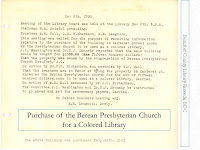
Because of racial segregation, the Beaufort Township Library Board of Trustees purchased the Berean Presbyterian Church in 1931 for $1500.00 in order to provide a library facility for African-Americans. Geneva Green was named Librarian. In 1938 after the death of the prominent African-American attorney who sought so hard to get a public library for Black Beaufortonians, the Colored Branch was re-named the J. I. Washington Public Library.

Here are a few photographs of Beaufort Township Library from our Beaufort County Library Records archival collection housed in the Beaufort District Collection:


By act of the General Assembly in 1962, the Beaufort Township Library was transformed into the Beaufort County Library. Shortly thereafter, the facility was integrated though the J.I. Washington Colored Library continued to operate until 1965.

You can review an abbreviated Library History on the Beaufort County Library's website.   

We suggest that you make an appointment to our Research Room for assured personalized service to review the contents of the Beaufort County Library Records and the contents of the Clover Club Records. We are privileged to take care of both archival collections in the BDC Research Room.