Showing posts with label open government. Show all posts

29 July 2018

Municipal Records in the BDC and on the Web

Latest updates: Courtesy of a customer, I share the link to the Town of Hilton Head Island's Historical Record Center. Browse the "Community Development Files" to find archaeological reports, historic photos, development plans, plats, etc. 10 May 2023 -- gmc

I added the link to the Nancy Ciehanski Papers Finding Aid, corrected broken links, updated the statistics re: the Summary Guide to Municipal Records, and deleted missing images and irrelevant references on 15 March 2023 - gmc

This is the final installment of a series of posts about local, state, and federal government records relating to Beaufort District.  Today's topic are records relating to the four municipalities in present-day Beaufort County: City of Beaufort; Town of Bluffton; Town of Port Royal; and the Town of Hilton Head Island. Please note: Few of these municipal records include the types of genealogical information that most researchers seek.  - Grace Cordial 

Each of Beaufort County's municipalities observe the legal requirements for public record-keeping and try to observe open government practices to encourage citizen involvement and participation in government activities, goals and operations, though each town may put its own touches to the release and distribution of documentation of the government's business. You can view lists of records relating to the municipalities in the South Carolina Archives Summary Guide to Municipal Records. The Archives lists 5662 record series that include 7,358 cubic feet of paper records and 15,137 microfilm reels of county and municipal records, but unfortunately not very many records for the municipalities in Beaufort County. 
City of Beaufort
Although Beaufort may have been founded as an English settlement in 1711, it did not incorporate until 17 December 1803. Unfortunately, records from those early years are few. We have some historical records for the City on microfilm in our Research Room: 
Ordinances of the Town Council, 1866-1915
City of Beaufort Minute Books, 1868-1882, 1911-1993
The Summary Guide to Municipal Records indicates that the Sheriff's Records for the City of Beaufort are located at the SC Archives.

The BDC Research Room have some maps authored by the City of Beaufort and several reports but the bulk of materials that we have about the City are located in the "Beaufort - City- Government" vertical file or in the "Keyserling, Billy" vertical file. 

For current documents, begin on the City of Beaufort website.
Town of Bluffton
Although settled in 1825 as Kirk's Bluff, Bluffton was incorporated in 1852, making it the second oldest municipality in Beaufort County. For almost all of its history, it was a very small settlement of approximately 400 - 1000 people. Growth accelerated in the 2010s when Bluffton annexed 32,000 acres of land thereby becoming the fifth largest municipality by area in South Carolina. Now the estimated population of Bluffton is18,897.

The Summary Guide to Municipal Records at the State Archives indicates no records for the Town of Bluffton.

The BDC Research Room has a few official documents authored by the Town of Bluffton in own holdings that you can find by using the catalog.

Explore the "Government" tab on the Town of Bluffton website. There you'll find its Code of Ordinances and some current municipal documents are posted online.


Town of Port Royal 
The Town of Port Royal logo sports the date 1562 referring to Charles Fort, the first Protestant settlement in North America which was located on nearby Parris Island. The town of Port Royal was incorporated in 1874 in the flourish of activity surrounding the opening of the Port Royal Railroad and associated port. 

The Town of Port Royal website includes a "Government" tab which has the town's ordinances. 

Last in creation, but not least, is Beaufort County's youngest municipality, the Town of Hilton Head Island.


Town of Hilton Head Island
The current version of the Town of Hilton Head's logo has a ghosted image of its earlier logo. The earlier logo included the date 1663 when Captain William Hilton espied the island while on an exploration for the English government and 1983 the year when the town was incorporated. Only 35 years old, the Town of Hilton Head Island was designed as a "limited services" town, primarily to wrest planning and development oversight from the Beaufort County government.

I recommend Evolution of a Town by Buzz Carlota and Profits and Politics in Paradise: the Development of Hilton Head Island by Michael N. Danielson to those who would like to know more about the evolution of Hilton Head Island's municipal government. For those of you who are wonks, the Nancy Ciehanski papers can provide lots of insight. She was very involved in the Beaufort County Joint Planning Commission and the first Municipal Town Council.

The Summary Guide to 
Be sure to explore the Town of Hilton Head Island website. You can find important municipal documents through the "Government" tab to get a dropdown screen to then choose "Historical Record Search". 
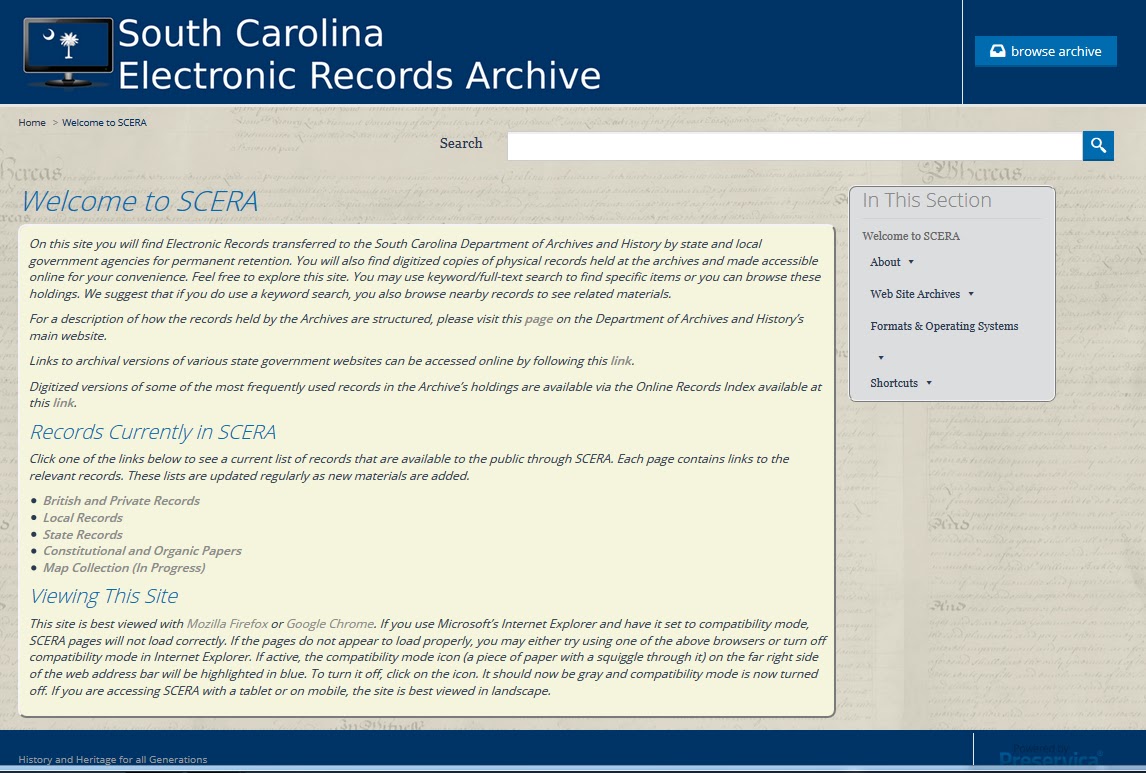
Note: The South Carolina Electronic Records Archive (SCERA) continues to add materials in digital form. Some municipal records may be available online. 

20 March 2016

SCDAH Electronic Records Archive Launched

I am a little tardy in sharing this with you but the SCERA brings in a new era of access to state government records. It may take a little time to understand the ins-and-outs of the database but it is sure to help researchers uncover the past and citizens to hold government accountable.


FOR IMMEDIATE RELEASE: February 22, 2016

State Historical Agency Announces the Creation of the South Carolina Electronic Records Archive

Columbia, SC - The South Carolina Department of Archives and History (SCDAH), a state agency established in 1905 with the mission of preserving and promoting South Carolina history, is proud to announce the creation of the South Carolina Electronic Records Archive (SCERA). The new electronic records archive currently houses 450 GB of records that are now available to the public through an easily searchable website, e-archives.sc.gov.

Go to e-archives.sc.gov


The unveiling of SCERA marks a dramatic step forward in the agency’s efforts to make its vast historic collections available to the public in a manner that is most convenient for its users. The creation of SCERA was made possible by the agency’s partnership with Preservica, a digital preservation software solution used by archives worldwide. “Every record in our collection is worthy of the universal accessibility we’ve been able to apply using the new digital preservation system,” says Bryan Collars, Electronic Records and Imaging Supervisor at SCDAH. “When the holdings of an archive are as historically important as ours, we take real pride in knowing that the world now has access to it.” Collars states that the project is ongoing, and SCDAH will continue to add electronic records to the archive as quickly as possible. “By introducing a digital preservation system, we can encourage more state and local government agencies to transfer electronic records, which will in turn help grow SCDAH’s collections while reducing storage costs for other agencies.”

Dr. W. Eric Emerson, SCDAH Director and State Historic Preservation Officer, noted that “the creation of the South Carolina Electronic Records Archive places SCDAH at the forefront of state archives nationwide, and we are working diligently to preserve and make available to the public the ever-growing number of electronic records that will be of historic value.”

Among the records you'll find is this composite photograph of the Members attending the 1895 South Carolina Constitutional Convention. There were 6 Black Men in attendance, five of whom represented Beaufort County during the convention: Robert Smalls; Thomas E. Miller; William J. Whipper; James Wigg; and Isaiah Reed. 


I was a little disappointed not to see Beaufort County listed in the Local Records page yet which may be due to the fact that you can gain access to some Beaufort County Council records through the Beaufort County government website http://www.bcgov.net/departments/Administrative/beaufort-county-council/minutes/index.php. 

Here is a list of the Beaufort County records we have on microfilm in our Research Room:

Council Minutes, 1888-2001

Council Resolutions and Proclamations, 1974-2000

Council Ordinances, 1970-2000
Register of Physicians & Surgeons, 1882-1992
Equity Decree Book, 1867-1876
Confederate Veterans Enrollment, 1919-1921
Voter Registration Book and List, 1957-1962
Calendar File Book (Common Pleas), 1974-1977
Bonds of Public Officials, 1984-2002
Register of County Offices, 1866-2002
Coroner’s Inquisition Books, 1888-1898, 1932-1951 

(Beaufort County offers a link to its financial information via the Tyler's Citizen Transparency database: http://openbooks.tylertech.com/_layouts/FormsBasedAutomatedLogin/loginOne.aspx?ReturnUrl=%2fbeaufort%2f_layouts%2fAuthenticate.aspx%3fSource%3d%252Fbeaufort%252FTransWebPages%252FHome%252Easpx&Source=%2Fbeaufort%2FTransWebPages%2FHome%2Easpx)
 
 
As one of the oldest state archives in the United States, the South Carolina Department of Archives and History is the repository for documents covering South Carolina’s 346-year history. It houses records from as early as 1671, representing the overwhelming majority of state and local government agencies. The agency is located at 8301 Parklane Road in Columbia, and its Research Room is open to the public Tuesday-Saturday, 8:30 AM to 5:00 PM.

For more information about SCERA, please contact Grace Salter, Agency Advancement Coordinator, at 803-896-0339 or at gsalter@scdah.sc.gov.

If you have any questions about government records (or any of our collections) housed here in the Beaufort District Collection, please contact us: 843-255-6468 or gracec@bcgov.net. 

14 March 2016

Citizen - Archivists Shine Light on Government!

Latest update: 23 October 2024 - gmc
Sunshine Week is a national initiative to promote open government and freedom of information. This non-partisan, non-profit initiative is celebrated in mid-March each year to coincide with the birthday of the "Father of the United States Constitution," James Madison, that is, March 16, a.k.a. National Freedom of Information Day.  This national initiative is sponsored by the American Society of News Editors and Reporters Committee for Freedom of the Press.


The goal of Sunshine Week is to enlighten and empower people to play an active role in their government at all levels, and to give them access to information that makes their lives better and their communities stronger. Sunshine Week presents an ideal forum to discuss accountability and transparency in government and learn more about the community in which we live - topics that are never out-of-date.

Good government is in everybody's interest. Here in the BDC we have some materials produced by the League of Women Voters about state and local government from the 1970s as well as Harriet Keyserling's memoir about her terms in the SC Legislature. A good portion of the Nancy Ciehanski archival collection concerns her involvement with the Hilton Head Chapter, League of Women Voters, her political offices and appointments, and community activities during the 1980s. We have an extensive collection of DVDs filmed by the County Channel of Beaufort County government meetings 2008 - 2012. And of course, we provide back files of many local newspapers on microfilm where you can learn about government at all levels: city, county, state, national and international. 
 
How can you participate in Sunshine Week? You could come check out our holdings mentioned in the previous paragraph. You could attend a government meeting. You could investigate current candidates running for office. Or you can even help the National Archives transcribe documents to celebrate open government. 
The National Archives is looking for Citizen-Archivists to transcribe records this week. As it says, "every transcription helps 'unlock' the information and helps open government records." All you need is the will to help and an internet connection.  Simply go to the National Archives website and accept a mission to transcribe a document based on a historical era. Its goal? That citizen-archivists transcribe a total of 2,000 pages of National Archives documents between March 13 - March 19. Transcriptions created by citizen archivists will enhance searches in the National Archives catalog and will be added to DocsTeach, the online tool for teaching with documents from the National Archives.


Are you ready to accept the challenge? Ready. Set.
Transcribe!
See our schedule below for the historical eras of our Sunshine Week transcription missions.
  • Sunday, March 13 – Revolution and the New Nation (1754-1820s) and Expansion and Reform (1801-1861)
  • Monday March 14 – Civil War and Reconstruction (1850-1877) 
  • Tuesday, March 15 – The Development of the Industrial United States (1870-1900) 
  • Wednesday, March 16 – The Emergence of Modern American (1890-1930)  
  • Thursday, March 17 – The Great Depression and World War II (1929-1945)  
  • Friday, March 18 – Postwar United States (1945 to early 1970s)  
  • Saturday, March 19 – Contemporary United States (1968-Present) 
New to transcription? Learn how it works.

Questions or comments? Email us at catalog@nara.gov.