Collection development (also known as collection management) is the term used to describe the evaluative process used by librarians to choose the items to be included in a particular library or sub-section thereof. There are many factors and variables that a librarian must take into account in this process (e.g. budget/pricing, accessibility, audience, popularity/reliability, trends, etc.). And, every couple of years or so, librarians revisit collection development documents. The latest version of the Library System's document is found at http://www.beaufortcountylibrary.org/content/beaufort-county-librarys-collection-development-policy. This document applies to the regular circulating branches of the Library system where the stock is often under continuous change.
The situation in a special collections and archives unit like the Beaufort District Collection is a little different. Every item in our collection has to be used in our Research Room under monitored conditions. What gets chosen for our collection has to stay in our collection forever. Therefore, we do not concentrate on the newest and brightest materials or the most popular or the highest demand titles within the general publishing sphere. Our goal is to grow, maintain, and share a research collection of permanent and enduring value about a very narrow scope, that is, about the history, culture, and natural environment of the people, places, topics, events, and themes of this particular part of lowcountry South Carolina.
For a special collections librarian and archivist, the selection process can be quite time-consuming. It can sometimes be rather difficult particularly when a proposed donation just doesn't "fit" our policy. But on the whole, it is a fun professional exercise.
As a rule of thumb, a material proposed for inclusion in the Beaufort District Collection must be about the history, culture and/or natural environment of this unique area. We don't get hung up on the form of the information. Our focus is the content first, then the package that contains the content. We take care of a variety of formats: books, magazines, DVDs, VHS tapes, cassettes, phonograph records, photographs, digital images, maps, art prints, and even a couple of samples of phosphate rock. An appropriate material for inclusion in the Library system's local history special collection and archives could be just about anything that would help illuminate the history, culture, and environment of this particular area - although we try to stay away from acquiring realia as that is more the province of our colleagues in the museum field.
Because we are a special collection and an archives, our materials do not always come in discrete pre-packaged form (book, DVD, or magazine). The crucial element in those cases is how much of the material actually informs on the history, culture, and natural environment of the former Beaufort District in relation to the other topics included in the material being considered. Generally speaking, if the applicable part of the pre-packaged form is 20 pages or less, we simply photocopy the appropriate pages (with proper citation, of course) and add the photocopies to the proper historical vertical file. Doing so allows us to shepherd our very limited budget for purchasing items.
If we are considering an audio-visual material, we figure in whether or not we have the appropriate hardware and/or software to view and migrate the material (We have that long-term 100 year watch, you know) and the amount of relevant information about Beaufort District within the package.
When considering whether or not to accession personal papers or other archival material, we weigh out the amount of original and unique information likely contained therein about the people, places, events, and themes of Beaufort District history, culture and the natural environment, the cost and time frame of preparing the materials for use, preserving the materials for use, arranging and describing the materials for use, and the amount of space the collection will need for proper storage. With a staff of only two, and a few dedicated docents who do a lot of the routine preservation tasks, the labor and time factor necessary to get the materials under intellectual and physical control for use by customers is very important consideration in whether or not we ultimately add a particular collection to the archives.
In other words, in special collections and archives, the process of acquiring materials involves analysis, assessment, and evaluation, and can ultimately be more art than science.
Focusing on local history, Gullah culture, genealogy, natural history,and archaeology of lowcountry South Carolina's historic Beaufort, Hampton and Jasper counties.
Showing posts with label participatory librarianship. Show all posts
22 November 2013
05 July 2012
Got a Little Time to Spare? Volunteer for a Focus Group.
Volunteers are still needed for the Focus Groups preceding the launch of the Library's "One County Reads One Country" project.
You can help us measure the impact of this grant funded project by sharing what you already know about Afghanistan as part of the pre-survey. Your knowledge can range from neophyte to expert. We won't be "testing" you or assigning grades. We just need a baseline to begin the evaluation portion of the project.
At the conclusion of the project in October, we'd like to be able to compare pre-project knowledge and understanding of Afghani culture, history, and current events with your post-project knowledge of understanding of Afghani culture, history, and current events. We need your help to do so.
Please step up and volunteer to help Beaufort County Library continue to provide relevant, thought-provoking, and timely programming for all our residents.
You can help us measure the impact of this grant funded project by sharing what you already know about Afghanistan as part of the pre-survey. Your knowledge can range from neophyte to expert. We won't be "testing" you or assigning grades. We just need a baseline to begin the evaluation portion of the project.
At the conclusion of the project in October, we'd like to be able to compare pre-project knowledge and understanding of Afghani culture, history, and current events with your post-project knowledge of understanding of Afghani culture, history, and current events. We need your help to do so.
Please step up and volunteer to help Beaufort County Library continue to provide relevant, thought-provoking, and timely programming for all our residents.
25 February 2012
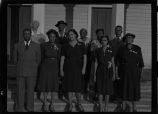
Can You Help Identify These Church Women?
![]() |
| Women's Group,1st African Baptist Church |
Church women have always been more powerful than society often credits them. Sometimes women are the "true movers and shakers" within a religious organization. We would like to know more about these women (and the men) and their respective roles at First African Baptist Church in order to share the information with the rest of the world.
I am truly hoping that someone will be able to identify one of these women as Mrs. Eliza Middleton Washington, widow of Julius I. Washington, subject of a Connections post a few days ago.
What do we know about and from the photograph?
- It's a formal photograph taken on the porch of the First African Baptist Church.
- Everyone appears to be in their "Sunday clothes."
- We do not have an exact date the image was taken by Lucille Hasell Culp of Palmetto Studios but given the attire of the people in the
photograph we estimate that it was taken during the 1950s or early
1960s.
- Seven of the women are wearing a ribbon above their right breast. The woman at F4 is blocking the right breast area of the woman at B4 so we cannot know for certain that each of the eight women are wearing a ribbon. However, neither man is wearing a ribbon.
What we cannot tell from the image
or Mrs. Culp's notations are the answers to these questions:
1.
Does the ribbon represent membership
in a specific church group?
2.
What are the names of the
individuals in this photograph?
3.
What was the occasion or event?
4.
What was the date this image was
taken?
But you might know. If you do know, please let us know! How? Click on the permalink to get to this image hosted by the Lowcountry Digital Library. From that permalink you can zoom in on the individuals to see if you recognize anyone. If you do, please, please, please "Add a Comment" in the Comment section towards the bottom of the page under the image.
About the people in the photograph: It would be very helpful to us if you use this code to indicate who you've recognized. Going left to right:
Front Row: F1. Man with double-breasted suit coat F2. Woman wearing glasses and a corsage F3. Woman wearing a pearl necklace and two bracelets F4. Thin Woman with a floral belt at her waist F5. Woman with a banded hat
Back Row: B1. Woman with glasses, white hair, print dress with white collar B2. Woman wearing dress with lace collar and a brooch with hat B3. Woman with greying hair, glasses and cutwork collared dress B4. Woman in a print dress with a beret B5. Man wearing glasses and a striped shirt in a single-breasted suit coat
As an example, let's say that the woman in the back row at position 4 described as "Woman in a print dress with a beret" is actually your great-aunt Jane Doe. In your comment write: "B4 is Jane Doe."
If you'd like to share more information about her, your relationship to her, or her role at the First African Baptist Church, please do. Just be aware that everything you write may be visible to rest of the world. So if she was an old scold, you may want to keep that to yourself. But if she was a Church mother from 1932 until her death in 1978, we would be glad to have that information in our permanent description of the photographic negative.
02 November 2011
Sea Island Hurricane of 1893: A Guide to Resources
Yesterday, 35 people attended our BDC@ The Branches program for the Bluffton Branch History Book Club session on The Great Sea Island Storm by Bill and Fran Marscher. We even had some folks sitting in the hall. Bratton DeLoach and I were delighted to have such a crowd! I showed images of some of our BDC holdings relating to the Hurricane of 1893 that devastated this area - and now everyone who came knows that I don't think much of our former governor, Benjamin Tillman. (What a mean and hateful man he was. And, yes, that is a moral judgment - which I will stand by!)I've compiled a guide to resources about the storm that I used to prepare the review and program. Halle Eisenman, who's still doing double-duty as Reference Manager at Hilton Head Branch and webmistress, posted the guide post haste in one component of the "Virtual BDC," viz., "Local History Treasures Brought to You by the Beaufort District Collection" within the librarian-chosen "Recommended Reading" page. (There are 6 components of the "Virtual BDC" in all).
Q: How do you find the "Virtual BDC?"
A: Start at our Library's homepage, that is, at www.beaufortcountylibrary.org.
Option 1: Choose the "Local History" tab. It's the third one in the blue row of column headings.
5 of the 6 components of the Virtual BDC are accessible through the "Local History" tab. Here you'll find direct links to the BDC homepage, Local Obituary Index, Connections, the Donner Digital Collection of phosphate industry and early 20th century farming, and the index to the 50+ Local History & Nature pages. But there's more...
Option 2: See the "Quick Links" section in the left column under the tan Library Catalog box? Recommended Reading is among the choices. Click Recommended Reading.
About 1/2 way down, you'll see a section labeled: "Local History Treasures Brought to You by the Beaufort District Collection." There are 35 (as of today) lists of materials about people, places, and topics important to Beaufort District's history within these guides. The one on the "Sea Island Hurricane of 1893" posted just this morning has a red "New!" beside it.
Taken together, the "Virtual BDC" got approximately 50,000 hits last FY year. Please help me make that 60,000 for this FY by taking a few minutes to explore the offerings.
Given that there is a big push for "Participatory Librarianship" these days, I'd love to get your comments on how to improve and enhance our current offerings within the "Virtual BDC." Contact me at gracec@bcgov.net or make a comment to this post.
Subscribe to:
Posts (Atom)